
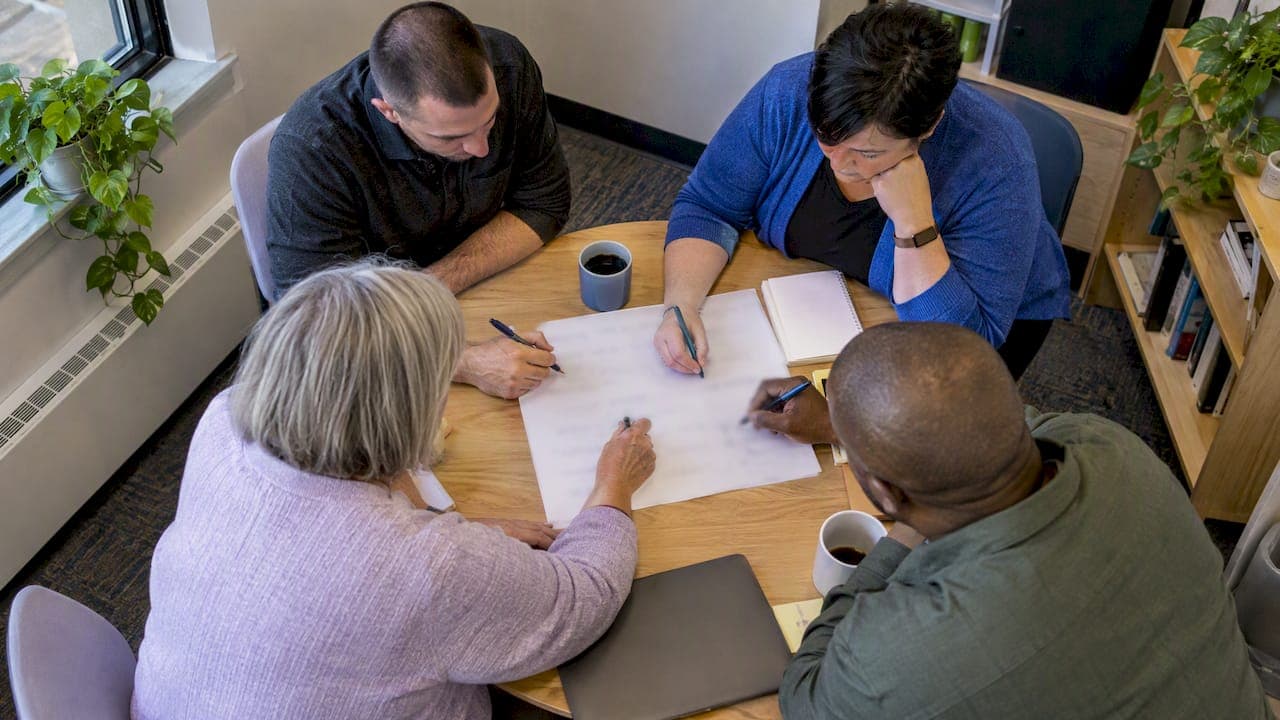
DISC team norms are the specific, agreed-upon behaviors a team adopts, informed by its members' DISC tendencies, that govern how they run meetings, give feedback, and make decisions together. When a team names these norms out loud instead of leaving them unspoken, meetings run tighter, fewer comments get misread as criticism or evasion, and the group builds the kind of trust researchers call psychological safety. Below, we walk through how styles shape behavior, how to co-create norms together, and how to keep them alive.
TL;DR:
- Run a 60 to 90 minute workshop when a team forms, reorganizes, or adds a member, and share individual DISC reports beforehand.
- Use behavior and deadline wording for each norm, invite revisions instead of forcing a vote, and document the agreed list with an owner.
- For major decisions, confirm the outcome within 48 hours of discussion, while allowing any team member to request one additional day before finalization.
- Review norms at onboarding, 30 and 90 days, and after reorganizations or hybrid shifts; schedule a 30 day follow up before the workshop ends.
- Use DISC to discuss observable behavior, not to label colleagues; revisit agreements when team needs change rather than enforcing outdated wording.
Table of Contents
- How the four DISC styles shape unwritten team norms
- How to co-create DISC-informed team norms step by step
- Copy-ready norms you can adopt this week
- Keeping norms alive: cadence, measurement, and why it matters
- Facilitator playbook: running a 60 to 90 minute DISC norms workshop
- Why we treat DISC styles as tendencies, not boxes
- How DISC Assess supports teams building these norms
- FAQ
- Sources
How the four DISC styles shape unwritten team norms
Every team already has norms. The question is whether they were chosen on purpose or whether they just accumulated, often shaped by whoever talks first or loudest. DISC gives us a vocabulary for naming those patterns before they calcify into friction.
A person with a D (Dominance) tendency usually pushes for speed and bottom-line clarity. Left unchecked, that tendency can turn into a norm where decisions get made before quieter voices weigh in. An I (Influence) tendency favors energy, brainstorming, and public recognition, which can tilt meetings toward talk and away from follow-through. An S (Steadiness) tendency values consistency and wants time to process before committing, so a team full of steady types may avoid conflict rather than name it. A C (Conscientiousness) tendency pulls toward accuracy and documentation, sometimes at the cost of speed.
These tendencies collide in predictable ways. A D pushing for a same-day decision and an S needing a night to think it over will read each other as reckless or slow, when both are simply following their wiring. Facilitators working with science and research teams note that this kind of friction is productive when a team has agreed norms to structure it, and corrosive when it is left to chance.
A few diagnostic prompts help surface where style is driving behavior before it becomes a problem:
- Ask in a one-on-one: "When we disagree in meetings, what happens next, and does that feel fair to you?"
- Run a quick pulse question: "Do you feel comfortable raising a concern before a decision is finalized?"
- Watch for patterns: who speaks first, who gets interrupted, and who stays quiet until asked directly.
Naming these patterns as tendencies, never as fixed labels, keeps the conversation about behavior rather than personality judgments.
How to co-create DISC-informed team norms step by step
The best time to run a norms conversation is when a team forms, after a reorganization, or when a new member joins and the old unwritten rules no longer fit everyone. Waiting until conflict forces the issue makes the conversation defensive instead of constructive.
Before the session, gather a few pieces of preparation: brief DISC results for each person (an individual assessment works fine for this), a shared document or whiteboard, and a simple agenda. The Center for Creative Leadership's 10-step approach and the University of Pennsylvania's guide to establishing team norms both point to a collaborative, step-by-step format as the one that sticks.
- Frame the purpose. Explain why the team is doing this now and what good norms will fix.
- Surface current norms. Ask what unwritten rules already exist, good and bad.
- Name the friction. Invite examples of moments where style differences caused a misread.
- Co-create norms using "We ___ by ___" phrasing. For example, "We confirm decisions by end of day Thursday."
- Vote and refine. Narrow the list to norms everyone can commit to, not just tolerate.
- Document and assign ownership. Put the final list somewhere visible and name who keeps it current.
When someone disagrees with a proposed norm, do not force a vote immediately. Ask what would need to change for them to say yes, and adjust the wording rather than the principle. Workable consensus beats unanimous enthusiasm.
Pro Tip: Close the session by drafting a one-slide summary of the norms and adding it as the first slide in your next team meeting, so the agreement is used immediately rather than filed away.
Copy-ready norms you can adopt this week
Teams rarely need more norms. They need better-worded ones. Borrowing language and adjusting it to your group gets you moving faster than starting from a blank page.
- Meeting norm: "We start on time and pause for questions before moving to the next agenda item," which gives both fast-paced and detail-oriented members what they need.
- Feedback script: "I value this idea. Here's one tweak I'd suggest," which opens with recognition before the critique, a structure that works well for I and S styles especially.
- Decision norm: "We confirm major decisions within 48 hours of discussion, and anyone can request one more day before it's final."
- Remote norm: "We treat chat messages as same-day response and email as next-business-day response," which removes the guesswork hybrid teams often struggle with, a pattern covered in more depth in how DISC supports remote team connection.
- Onboarding script for leaders: "Here are the norms this team runs on, and here's why we built them this way." Walk new members through the list in their first week rather than letting them infer it.
These are starting points, not scripture. The guide to establishing team norms recommends keeping the final wording short and behavior-specific, since vague norms are the ones teams forget to follow.
Keeping norms alive: cadence, measurement, and why it matters
A norms document that nobody revisits becomes decoration. Build review into the calendar from the start: check norms during onboarding for new hires, again at 30 and 90 days, and any time the team goes through a reorganization or a shift to hybrid work. The 10-step framework from CCL treats norms as living agreements rather than a one-time document, with a plan for revisiting them built in from day one.
A few lightweight measures keep this honest without adding bureaucracy:
- Run a quick meeting audit: list recurring meetings, their purpose, and whether they still follow the agreed norms.
- Ask three pulse questions quarterly: "Do you feel heard in meetings?" "Are decisions clear once made?" "Do you know how to raise a concern?"
- Use one-on-ones to check whether a specific norm is working for that person, not just the group.
Team psychological safety is positively associated with employee innovative performance, with communication behavior acting as the mechanism connecting the two. In practice, that means the norms conversation is not a soft exercise. It is the groundwork that makes people willing to share a half-formed idea instead of sitting on it.
When a norm breaks down, treat it as a renegotiation, not a failure. Bring it back to the group, ask what changed, and adjust the wording together rather than enforcing the old version by fiat.
Facilitator playbook: running a 60 to 90 minute DISC norms workshop
A focused session, run well, is enough to get a small team from unspoken assumptions to a working document. Here is a structure that holds up across most team sizes.
- Open and frame (10 minutes). State the goal: build norms the team actually uses, not a wish list.
- Share individual DISC results (15 minutes). Each person gives a one-line summary of their style and one thing it means for how they work best.
- Review the group report (15 minutes). Walk through the team's overall style distribution and flag where the group leans heavily toward one or two styles.
- Debrief the Custom Group Report + Video Analysis (15 to 20 minutes). Play the walkthrough and pause to ask, "Where do you see our team in this?" This is where abstract style talk turns into specific agreements.
- Draft norms using "We ___ by ___" phrasing (15 to 20 minutes). Work through meeting, feedback, decision, and remote norms in turn.
- Confirm and assign ownership (10 minutes). Vote, document, and name who updates the norms sheet going forward.
Distribute individual reports a day or two before the session so people arrive with some self-awareness already formed, rather than reading cold in the room.
- Use the group report to name patterns, never to rank people.
- Keep the final document to one page; longer lists get ignored.
- Schedule a 30-day follow-up before the session ends, not after.
Pro Tip: The most common pitfall we see is treating the workshop as a one-time event. Build the 30-day check-in into the calendar before anyone leaves the room.
For additional scripts to handle tension as it comes up live, four quick moves to calm meetings using DISC conflict styles gives facilitators specific language to use in the moment.

Why we treat DISC styles as tendencies, not boxes
The most useful thing we have learned facilitating small teams is that norms work better when nobody feels filed into a category. "She's just a C, she'll want more detail" is a label. "Let's agree to share the data a day ahead so everyone has time to review it" is a norm. Both might come from the same observation, but only one builds trust.
Treat DISC as a lens for noticing patterns, not a verdict on anyone's worth to the team. Norms built this way stay living agreements, open to renegotiation as the team itself changes.
— Tres
How DISC Assess supports teams building these norms
We built our tools so small teams and nonprofits could run workshops to support team norms without hiring an outside consultant. An individual assessment gives each person the self-awareness piece before the session starts. Our Custom Group Report + Video Analysis gives facilitators a ready-made debrief to walk the team through its collective style pattern. A group admin account or Extended Pro Membership supports facilitators running this process across multiple teams over time.

Start with a group package or individual assessment and bring your results into your next norms conversation.
FAQ
What are some good norms for a team to adopt?
Strong norms are specific and behavior-based, such as agreeing when decisions are considered final or how quickly team members respond to messages. The guide to establishing team norms recommends "We ___ by ___" phrasing because it names the behavior and the timeline together.
How do I know which DISC style is causing a specific team conflict?
Look at the pattern rather than the person: fast decision-making paired with frustration over missed detail often points to a D and C mismatch, while a push for consensus that stalls progress often points to an S and D mismatch. A short pulse survey or one-on-one check-in usually surfaces the pattern within a week or two.
Is there a "rarest" DISC style?
Definitions of style frequency vary by sample and assessment provider, and no single authoritative figure applies across all populations. Rather than chasing rarity, focus on how the styles present on your specific team and build norms around that mix.
Should we re-do our team norms every time someone new joins?
Not a full rebuild, but a short review makes sense whenever a new member joins, since the group's style mix has changed. The CCL framework treats onboarding as one of the natural checkpoints for revisiting norms.
How long does a norms workshop usually take?
A focused session runs 60 to 90 minutes for most small teams, covering individual results, a group debrief, and drafting the norms themselves. Larger or more complex teams sometimes split this into two shorter sessions.
Sources
- Facilitating psychological safety in science and research teams
- Guide to establishing team norms
- 10 Steps for Setting Team Norms | Center for Creative Leadership
- Team psychological safety and employee innovation (PLOS One)