
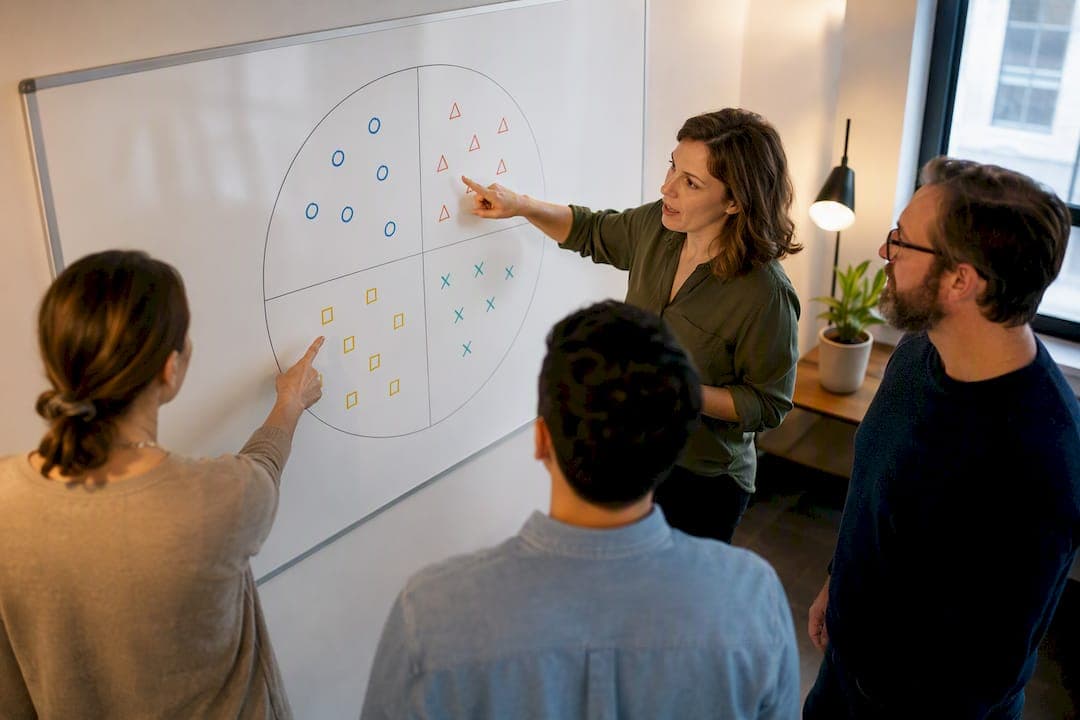
A DiSC team map is a visual snapshot of where every team member's style falls across Dominance, Influence, Steadiness, and Conscientiousness, showing your group's center of gravity, friction pairs, and communication blind spots in one view. Its real value is shared clarity: everyone sees the same picture of how the team naturally moves and where it stalls. Run one when a team is new, reorganized, stuck in recurring conflict, or onboarding fresh members.
TL;DR:
- Teams with no Conscientiousness representation risk delivering error-prone work or missing critical precision in their outputs.
- Friction pairs like high Dominance with high Steadiness or high Influence with high Conscientiousness lead to misunderstandings and communication breakdowns.
- Regularly scheduled, brief follow-up sessions keep the team map relevant and reinforce vocabulary around styles and behaviors.
- A team cluster towards Dominance and Conscientiousness indicates a tendency for fast decisions but potential impatience with process details.
- Deliberate pairing and specific behavior commitments help mitigate friction and embed map insights into daily team practices.
Table of Contents
- What a DiSC Team Map Is and How It's Built
- How to Read a Team Map: Center of Gravity, Friction Pairs, and Gaps
- Turning Map Insights Into Everyday Team Practices
- Six Ready-to-Run Activities Built Around Your Map
- What Common Team Patterns Actually Mean for Leaders
- Why the Map Matters More Than the Meeting That Follows It
- Piloting a Team Map With Discassess
- Sources
What a DiSC Team Map Is and How It's Built
A team map plots four styles at once. D (Dominance) style teammates push for speed and results. I (Influence) style teammates bring energy and persuasion. S (Steadiness) style teammates protect consistency and support. C (Conscientiousness) style teammates demand accuracy and structure. At the team level, these four styles sit on two crossing lines: a pace axis (fast versus measured) and a focus axis (people versus tasks). Where your group clusters on those lines tells you more about how meetings actually run than any org chart does.
The map is built from individual assessments. Each person completes a short questionnaire, typically consisting of a set of questions taking about six minutes, and the live map recomputes automatically as each new response comes in. That means a team map is never static during rollout. A five-person leadership team might look lopsided after three responses and balance out once the last two finish.
Most platforms render the results in one of three formats:
- A wheel or quadrant, showing where each person sits relative to the four styles
- A center-of-gravity marker, showing where the team clusters as a whole
- Bar comparisons, showing the count of each style represented on the team
Each format answers a slightly different question, and a well-built dashboard usually gives you all three on the same screen.
How to Read a Team Map: Center of Gravity, Friction Pairs, and Gaps
Start with the center of gravity before you look at anyone's individual dot. If most of your team clusters toward D and C, expect a group that moves fast on decisions but gets impatient with process discussion. If the cluster sits toward S and I, expect warmth and consensus, often at the cost of decision speed. The center of gravity is the single fastest way to predict how your next difficult meeting will feel before it happens.
Read the rest of the map in this order:
- Locate friction pairs. These are style combinations that tend to misread each other, most commonly high D paired with high S, or high I paired with high C. A friction-pair framework works best when you name the pair out loud, describe the actual cost (missed deadlines, quiet resentment, repeated miscommunication), and script how each side can adapt under pressure.
- Check for missing styles. A team with no C representation often ships work with avoidable errors. A team with no I representation may struggle to build buy-in outside the room. Missing styles are gaps you staff around, not flaws to fix.
- Note comfort zones. These are the tasks or conversations your team handles without friction. They're worth naming too, because leaders often only talk about what's broken.
Pro Tip: Record specific behavior examples during your first read, not just style labels. "Jordan pushed to skip the retro last Tuesday" teaches the team more than "Jordan is a high D."
Turning Map Insights Into Everyday Team Practices
A map that stays in a slide deck changes nothing. The leaders who get value from theirs convert each readout into a specific practice within a week of the first read.
- Write meeting norms from your pace and focus findings, then post them somewhere visible. A D and C heavy team might adopt "decide now, adjust later" for routine calls; a team split across the pace line might need both a fast-decision norm and a slower-review norm depending on the stakes. Naming the norm out loud does more work than most leaders expect, and displaying it where the team can see it keeps it from quietly disappearing after week one.
- Assign pairings deliberately. If your map shows no C representation on a project, pair the D lead with whoever scores closest to C, even if that's not their strongest trait.
- Build one-line "working with me" playbooks. Each person writes a single sentence describing how they prefer feedback, deadlines, or disagreement, and the team keeps these somewhere accessible, similar to an org chart overlay. Ask each teammate to commit to one specific behavior change, not five.
- Set a rhythm. Run the first-read session now, then schedule a five-minute check-in once a month rather than a full re-facilitation.
For ready-made scripts you can copy into your next team meeting, Discassess's communication strategies guide gives you starting language instead of a blank page.
Pro Tip: Ask each person to bring one line from the map they disagree with to the first-read session. Teams that argue with the map early tend to actually use it later.
Six Ready-to-Run Activities Built Around Your Map
Each of these ties directly to a specific map readout, and none require an outside facilitator.
- First read session (10 to 30 minutes). Review the whole map together before anyone comments on individual profiles. Set one ground rule: no performance conversations, no style shaming.
- Pace and focus lines exercise. Have the team stand along an imaginary line from fast to measured, then debrief with one agreed sentence: "We move at [pace] and we protect [focus]."
- Playbook swap. Everyone silently reads a teammate's "working with me" note, shares one observation out loud, and commits to one concrete change.
- Missing-style advocate. Assign someone to argue for the perspective the map shows is absent (usually C for accuracy, or I for buy-in) during the next real decision.
- DISC-based role-play, using scenarios pulled straight from actual friction pairs on the team, is a proven way to make the map stick in daily behavior.
- Micro follow-up. Pick one activity per month rather than repeating the full session, keeping the map active without turning it into a chore.
What Common Team Patterns Actually Mean for Leaders
Certain map shapes show up again and again, and each one calls for a different first move.
- D-heavy teams decide fast and argue often. The risk is steamrolling quieter styles before their input surfaces. Fix: build a rule that no decision closes until every style has spoken once.
- I-clustered teams generate energy and ideas but lose follow-through. Fix: pair every initiative with a written owner and a deadline, not just enthusiasm.
- S and C centered teams protect quality and consistency but can stall on speed. These teams usually just need a faster decision cadence, like a standing 48-hour deadline on routine calls, rather than a personality intervention.
- When friction runs deep, meaning the same two people clash across multiple projects, that's usually the signal to bring in outside facilitation rather than trying to solve it with another internal meeting.
Why the Map Matters More Than the Meeting That Follows It
Most teams treat a DiSC session as a one-time event: everyone gets their report, nods along, and goes back to work exactly as before. That's backwards. The map itself is disposable. What matters is whether the language it introduces, terms like "friction pair" or "comfort zone," actually enters your team's ordinary vocabulary during a normal Tuesday standup.
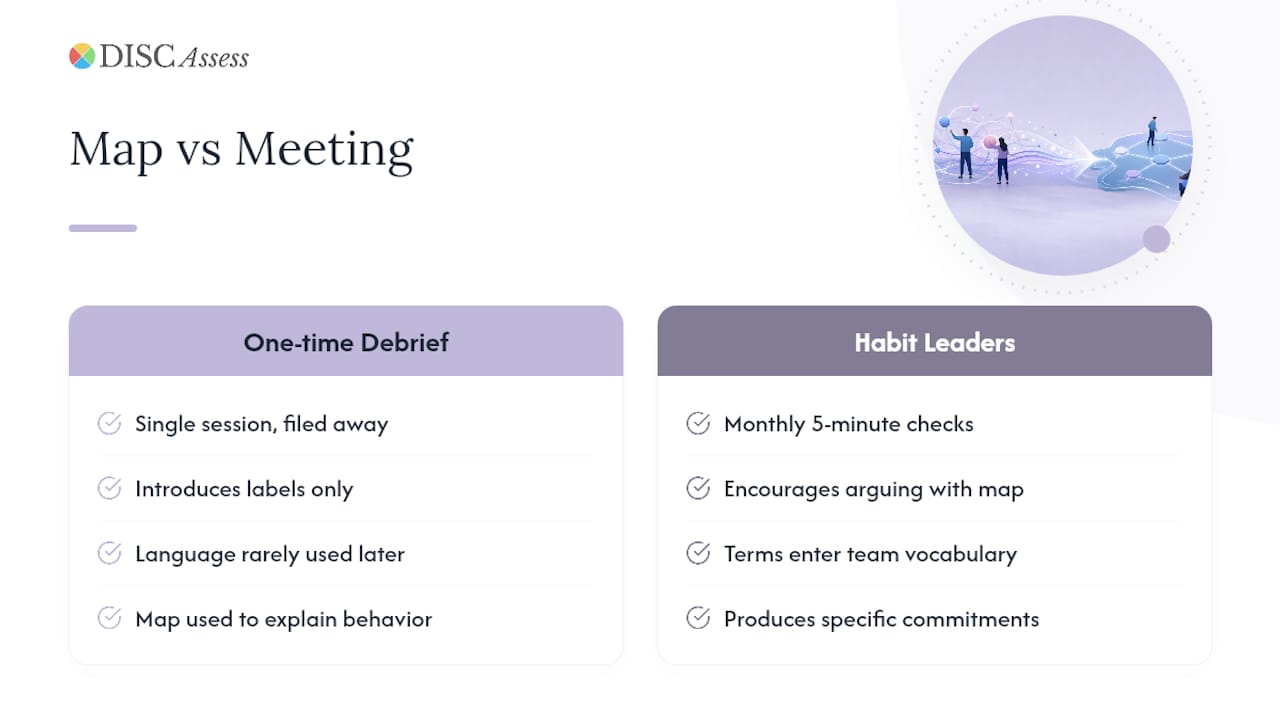
The teams that get real mileage out of a map are the ones willing to argue with it. When someone pushes back on their own style label in the first-read session, that's not resistance to manage. That's the moment the map starts doing its job. Leaders who treat the debrief as a closed conversation, delivered once and filed away, waste most of the tool's value. Leaders who build one small, recurring habit around it, a monthly five-minute check, a visible meeting norm, get compounding returns from a single assessment cycle.
The other mistake worth naming: using the map to explain away behavior instead of change it. "That's just how I am, I'm a high D" is a diagnosis, not an excuse. A map that only produces labels has failed. A map that produces one specific behavior commitment per person has succeeded, whether or not the labels ever come up again.
— Tres
Piloting a Team Map With Discassess
Discassess builds these maps around the same practical need every small team leader has: clarity fast, without a certification requirement or a corporate price tag. The admin portal gives you a live dashboard as teammates finish their assessments, so you watch the map fill in rather than waiting on a delayed report.
Small teams can purchase assessment credits sufficient to get the whole group mapped, while departments or established teams may seek deeper interpretation and facilitator-style breakdowns using more comprehensive reports. Volunteer groups or growing organizations that plan to run repeated assessments may want packages with admin accounts and credits that carry over as the roster changes.
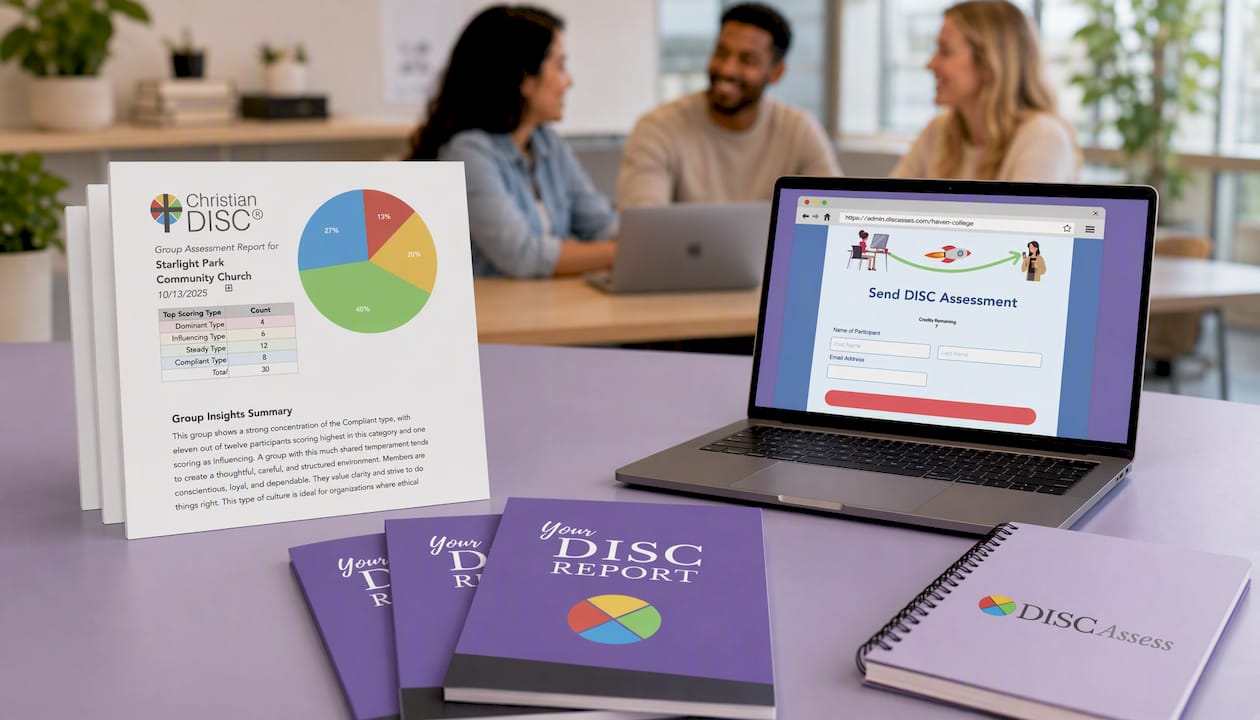
Getting started takes three steps: buy the credits or Starter Package that match your group size, send each teammate their invite link, and schedule the first-read session once the map fills in. Browse the full assessment catalog to compare packages before you commit.
Sources
- Free DISC Assessment for Team Building: Live Map + 6 Activities
- DISC Activities For Team Building: Fun And Engaging Ways to Boost Teamwork
- The 12 DiSC personality types and how to use them (practitioner guidance)