

In the DISC model, a Conscientiousness (C) style describes someone who brings precision, structure, and analytical thinking to every task they touch. This is the team member who reads the manual before starting, checks the numbers twice, and asks the question no one else thought to ask. For managers and team leaders, recognizing this style early changes how you assign work, run feedback conversations, and build a team that actually delivers quality.
Three practical implications to hold onto: High-C employees will slow down before a deadline to verify accuracy, not because they are stalling, but because correctness matters more to them than speed. They communicate better in writing than in spontaneous verbal exchanges. And they will disengage quietly if asked to skip steps or make decisions without enough data.
The clearest signal? A team member who consistently asks for documentation, follows up with written summaries after meetings, and hesitates before committing to a timeline is likely showing a high-C pattern worth exploring through a formal DISC assessment for teams.
Key Takeaways
The most practical thing a manager can do with a High-C employee is align their role to their behavioral strengths before addressing any performance concern.
| Point | Details |
|---|---|
| C style definition | High-C employees prioritize accuracy, structure, and methodical decision-making over speed. |
| Communication approach | Present facts first, use written instructions, and define measurable acceptance criteria for every task. |
| Blind spots to manage | Set time-boxed review windows and clear "good enough" thresholds to prevent analysis paralysis. |
| Best-fit roles | Compliance, quality assurance, data analysis, and technical writing are natural fits for High-C people. |
| Discassess reports | Use the DISC Assess report's behavioral language directly in 1:1s and role assignments for immediate impact. |
Table of Contents
- How does a high-C employee actually behave at work?
- What strengths does a High-C person bring to your team?
- Common challenges and blind spots for High-C employees
- How to manage and communicate with High-C employees
- Best-fit roles and team pairings for High-C styles
- How does Discassess identify Conscientiousness in a DISC report?
- Ready-to-use templates for hiring and feedback
- A team leader's perspective on using DISC C insights
- Measure Conscientiousness on your team with Discassess
- Sources
How does a high-C employee actually behave at work?
Understanding conscientious personality traits in the DISC model means watching for a specific cluster of observable behaviors, not guessing at internal motivation.
Day-to-day behaviors of a High-C employee:
- Prefers facts, data, and documented evidence before forming an opinion
- Makes decisions methodically, often building a pros-and-cons framework before committing
- Favors written communication: emails over hallway conversations, written instructions over verbal briefings
- Works independently and dislikes being interrupted mid-task
- Holds themselves to high personal standards, sometimes higher than the role requires
- Focuses on accuracy over speed when the two conflict
Two quick workplace examples bring this to life. An estimator reviewing a project bid will spend extra time cross-checking line items against historical cost data before submitting, even when the deadline is close. In a team meeting, a High-C participant often says little in the room but sends a detailed follow-up email afterward, because they needed time to process before responding.
What distinguishes C from other DISC styles is that focus on accuracy over pace. A High-D style pushes for a fast decision; a High-C style pushes for the right decision, even if that takes longer.
What strengths does a High-C person bring to your team?
High-C team members are the people who catch the error before it ships. Their strengths cluster around quality, process, and risk, and those contributions tend to show up most clearly in the outcomes they prevent rather than the ones they create.
Core strengths include:
- Quality control: They notice inconsistencies others overlook.
- Process design: They build repeatable systems that reduce variability.
- Risk identification: They ask "what could go wrong?" before the project launches.
- Data analysis: They are comfortable sitting with complex information and drawing careful conclusions.
Consider a small nonprofit finance team where one staff member consistently flagged grant reporting discrepancies before submissions went out. That single habit, rooted in a High-C behavioral style, prevented compliance issues that could have cost the organization its funding relationship. The value was not dramatic or visible day to day; it showed up in what didn't go wrong.
When a team member's behavioral style matches the demands of their role, performance and retention both tend to improve. Placing a High-C person in a quality-critical role is not just good management. It is alignment.
That alignment matters because High-C strengths translate directly into measurable outcomes: fewer reworks, stronger compliance records, and documentation that actually holds up under review.
Common challenges and blind spots for High-C employees
Every strength has a shadow side. For High-C employees, the same drive for accuracy that makes them valuable can also slow a team down or create friction in fast-moving environments.
Common challenges:
- Perfectionism: They may spend more time on a task than the situation warrants.
- Analysis paralysis: Faced with incomplete data, they may delay decisions indefinitely.
- Resistance to change: New processes feel risky until they are proven; they prefer tested methods.
- Reluctance to show emotion: They can appear cold or disengaged in collaborative settings.
Warning signs to watch for in performance reviews:
- Missed deadlines paired with high-quality output (perfectionism slowing delivery)
- Requests for more information on decisions that are already well-supported
- Pushback on new tools or workflows without a clear rationale
- Withdrawal from team discussions or conflict avoidance
The Center for Leadership Studies specifically highlights analysis paralysis as a risk for C styles and recommends setting clear deadlines alongside defined "acceptable quality" thresholds to prevent stalling.
Pro Tip: When a High-C employee is stuck in analysis mode, give them a time-boxed review window ("You have until Thursday at noon to finalize your recommendation") and name a single decision owner. This preserves quality without letting the process run indefinitely.
How to manage and communicate with High-C employees
Managing a High-C employee well means being precise, patient, and prepared. Vague feedback and rushed requests tend to shut them down rather than motivate them.
1:1 performance conversation checklist:
- Prepare specific facts and examples before the meeting, not general impressions.
- Open with data: "The last three reports came in at 99% accuracy. Here is where I want to focus next."
- State the standard clearly: define what "good enough" looks like for this task.
- Allow time for analysis: do not expect an immediate commitment to a new approach.
- Agree on next steps in writing and send a follow-up summary after the conversation.
Sample written feedback phrases:
- Praise: "Your audit of the vendor contracts caught four discrepancies that would have created billing problems. That level of review is exactly what this role requires."
- Corrective: "The proposal was thorough, and the deadline passed before it was submitted. Going forward, I need the draft by Thursday even if it is not yet perfect."
C-style communicators respond best when facts come before feelings and when requests are specific and measurable. Avoid vague statements like "I need you to be more flexible." Instead, say: "I need a first draft by Wednesday, with a note on any open questions."
Pro Tip: When delegating to a High-C employee, always provide written instructions and a measurable acceptance criterion. "Done when all line items match the approved budget" is far more useful to them than "just get it finished."
Best-fit roles and team pairings for High-C styles
High-C employees thrive in roles where precision, documentation, and careful analysis are the job, not just a bonus.
Roles and tasks where C excels:
- Compliance officer or regulatory analyst
- Quality assurance specialist
- Financial analyst or bookkeeper
- Technical writer or documentation specialist
- Project estimator or cost analyst
- Data reviewer or research coordinator
- IT systems auditor
- Grant writer or program evaluator (especially in nonprofits)
Pairing guidance for balanced teams:
| C Paired With | Dynamic | What the Pairing Needs |
|---|---|---|
| High-D | D pushes for speed; C pushes for accuracy | Clear agreement on decision timelines and quality standards |
| High-I | I generates ideas; C evaluates feasibility | Mutual respect: I must not dismiss C's caution as negativity |
| High-S | Both value stability; C adds structure | C should lead process design; S manages relationship continuity |
To structure an environment where High-C people thrive: document processes clearly, give them autonomy over their workflow, reduce unnecessary interruptions, and set explicit quality benchmarks. They do not need cheerleading. They need clarity.
How does Discassess identify Conscientiousness in a DISC report?
A DISC Assess report surfaces the C style through behavioral language tied to specific workplace tendencies. Knowing where to look saves time and makes the report immediately usable.
Report-reading checklist for managers:
- Look for phrases like "prefers accuracy," "works methodically," or "values quality standards" in the behavioral summary.
- Check the C score on the style graph: a score in the upper range indicates a primary or strong secondary C style.
- Review the "motivators" section for references to correctness, systems, or thoroughness.
- Note any "cautions" flagged around pace, change, or interpersonal directness.
Example action plan template (built from a DISC Assess C report):
| Step | Action | Owner | Timeline |
|---|---|---|---|
| 1 | Assign C employee to quality review role on current project | Manager | This week |
| 2 | Provide written task brief with measurable acceptance criteria | Manager | Before kickoff |
| 3 | Schedule a mid-project check-in with written agenda | Both | Week 3 |
| 4 | Debrief on outcomes using specific data from the report | Manager | End of project |
Discassess's admin portal lets you manage multiple team reports in one place, making it easy to compare styles across your group and spot where a High-C is already contributing or where they might be misaligned. The group package is built for exactly this kind of team-level review.
Pro Tip: Use the DISC report's behavioral language verbatim in your next 1:1. Saying "Your report notes that you prefer to verify information before committing" opens a more honest conversation than any general observation you could offer.
Ready-to-use templates for hiring and feedback
These copy-paste templates are designed for managers who want to identify or support High-C employees without starting from scratch.
Interview questions to identify C behaviors:
- "Walk me through how you check your own work before submitting it."
- "Tell me about a time you caught an error others had missed. What was your process?"
- "How do you handle a situation where you need to make a decision but feel you don't have enough information yet?"
- "Describe how you organize a complex project with multiple deadlines."
Feedback phrases:
- Praise: "You identified the compliance gap three weeks before the audit. That kind of proactive review is exactly what we need."
- Corrective: "I need your analysis by Friday. A solid draft with your top three findings is enough. Waiting for a perfect version costs us time we don't have."
Job description bullets that attract High-C candidates:
- "Maintains accurate records and documentation in compliance with [relevant standard]."
- "Reviews deliverables for quality and consistency before submission."
- "Develops and follows structured processes to reduce errors and ensure repeatability."
- "Works independently to analyze data and prepare detailed written reports."
A team leader's perspective on using DISC C insights
One of the most practical lessons I've seen from applying DISC Assess results in small teams involves a simple reassignment. A manager noticed that a staff member was consistently late on client-facing deliverables but produced flawless internal reports. The DISC report showed a strong C style. The manager moved that person from client deadline work to internal quality review, and the error rate on outgoing materials dropped noticeably within a month.
The lessons from that kind of shift are worth holding onto:
- Match the task to the style before you address the performance. A High-C person in the wrong role looks like a performance problem. In the right role, they look like your best hire.
- Use the report language in your conversations. It gives both of you a shared vocabulary that removes the personal edge from feedback.
- Small teams benefit most. When every person's contribution is visible, aligning style to role has an outsized effect on outcomes.
Measure Conscientiousness on your team with Discassess
If you manage a team of five or fifty, knowing who your High-C people are changes how you assign work, run reviews, and build processes that actually hold.
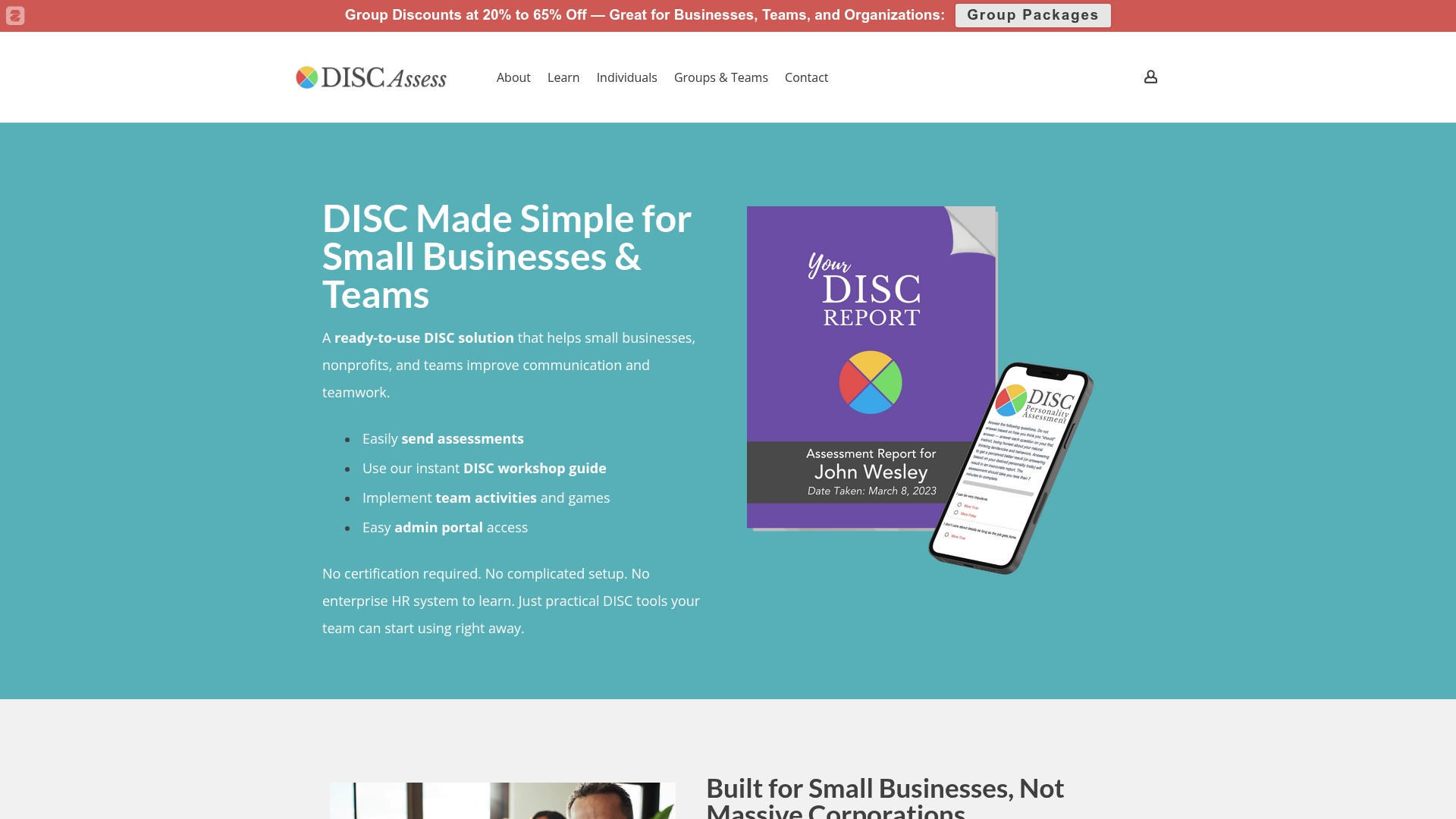
Discassess offers an Individual Classic DISC Assessment for managers who want to start with one team member, and a DISC Group Package for leaders ready to assess their whole team at once. Every report is instant, written in plain language, and built for practical use without an HR department or certification requirement. The admin portal lets you manage all results in one place, and live group training is available when you want a guided session for your staff. Start with one assessment or run your whole team this week at Discassess.
Sources
- DISC Assessment for Teams: Proven Communication Guide
- Leadershipstrength
- Adapting Your Communication Style to Each DiSC® Type - The Center for Leadership Studies
- Indeed