

Run a small pilot before you roll DiSC out to the whole team. Give each pilot member the assessment, hold a debrief to walk through what the results mean, and produce individual profiles plus a team map. That map becomes the anchor for a 30 to 60 minute team session where real communication agreements get made, not just talked about.
TL;DR:
- Conduct a small pilot with a diverse team group to ensure members can identify their style and plan one behavioral adjustment.
- Use activities like team mapping and role play to help the team internalize DiSC styles and practice adapting communication.
- Turn individual insights into team commitments and review progress after 90 days to reinforce behavior change.
- Maintain confidentiality by sharing only aggregated group results and avoiding using DiSC data for hiring or performance decisions.
- Expect a gradual shift, with initial skepticism from managers dissolving as they recognize their own styles and see practical improvements in meetings and collaboration.
Table of Contents
- What Is DiSC and How Does It Help Teams?
- How Do You Roll Out DiSC Across a Team?
- What DiSC Activities Work Best for Team Building?
- How Do You Turn DiSC Reports Into Team Agreements?
- What Mistakes Derail a DiSC Rollout?
- How DISC Assess Supports a Fast, Practical Rollout
- How Do You Explain DiSC to Your Team So People Actually Buy In?
- Why Do Teams Resist DiSC, and How Do You Get Past It?
- How Should You Adjust DiSC for Different Team Cultures and Remote Teams?
- How Do You Measure Whether DiSC Actually Improved Your Team?
- What Confidentiality Rules Should Govern Shared DiSC Results?
- What a Facilitator Actually Sees in the First 90 Days
- How DISC Assess Can Help You Start This Week
- Sources
- FAQ
What Is DiSC and How Does It Help Teams?
DiSC sorts behavioral tendencies into four styles: D (Dominance, direct and results driven), i (Influence, outgoing and relationship focused), S (Steadiness, supportive and consistent), and C (Conscientiousness, analytical and detail oriented). You see these preferences every day. The D who wants the bottom line before the backstory. The S who goes quiet when a meeting turns confrontational. Neither is a flaw. Both are patterns worth naming.
DiSC helps a team in three concrete ways:
- Shared language. "I need the summary first, details later" replaces vague frustration with a specific, nameable preference.
- Clearer attributions. A teammate's silence in meetings gets read as thoughtful processing instead of disengagement.
- Better task alignment. Assigning the detail-heavy audit to a C and the client pitch to an i stops feeling like guesswork.
One caution matters here: DiSC does not measure intelligence, skill, or job fit. It is decision-support for how people interact, not a scorecard for who is capable.
How Do You Roll Out DiSC Across a Team?
A single training day rarely changes how a team actually works. Behavior change needs a sequence, not an event. Here is the phased plan that holds up over time:
- Pilot. Include a small group of people, ideally a mix of managers and informal influencers. Success looks like: every pilot member can name their own style and one adjustment they will make in meetings.
- Manager practice. Managers start using profiles in one-on-ones, delegation decisions, and how they structure meeting agendas. This is where DiSC either becomes real or stays theoretical.
- Team workshops. Each person reviews their own report, the group builds a team map together, and the session ends with written commitments and a short team charter.
- Sustain. Fold DiSC language into onboarding for new hires, run regular check-ins, and revisit the original commitments after some time.
This staged approach, moving from individual assessment to personal presentation to reframing recent friction to documented commitments, tends to produce more durable behavior change than a one-time seminar, especially when a 90-day review is built in from the start.
Pro Tip: Have managers complete their own debrief and write down one behavior change before anyone else on the team takes the assessment. A manager who cannot articulate their own style has nothing credible to model in week two.
What DiSC Activities Work Best for Team Building?
Reading about DiSC and experiencing it are different things. Activities create the shared moment that makes the framework stick.
- DiSC Bingo. Build a 5x5 grid with squares like "prefers written instructions" or "interrupts to get to the point." Give the team some time to mingle and fill squares by matching traits to teammates. Debrief with: "What surprised you about someone's square?"
- Role play. Assign a common friction scenario (a missed deadline, a disagreement over project direction) and have pairs act it out once from each person's natural style, then again after swapping to a style they do not normally use. Observers note what changed in tone and pacing.
- Team mapping. Plot every member's style on a simple quadrant chart. A cluster of D and C styles with no i or S often explains why a team moves fast but struggles with buy-in.
- Escape-with-DiSC simulation. Give the team a puzzle that requires input from all four styles to solve, then discuss which styles drove which decisions and who got overlooked.
Practical, low-stakes exercises like these create the shared experience teams need to practice adapting their communication before the stakes get higher in real projects. For remote teams, the same activities translate directly into Zoom breakout rooms with a shared Miro board standing in for the physical bingo card or team map.
How Do You Turn DiSC Reports Into Team Agreements?
An individual report tells you what one person needs. A group report tells you what the team is missing. Reading both correctly is what separates a DiSC rollout that changes behavior from one that just generates interesting conversation.
Start with individual profiles. A high-D teammate's report might flag a need for autonomy and fast decisions, which explains why they disengage in long consensus-building meetings. A high-S teammate's report often points to a need for advance notice before change, which explains resistance that otherwise looks like stubbornness.
The group map matters just as much. A team with no C representation may consistently ship work with gaps in detail. A team clustered entirely in i and D may generate energy but struggle to close out follow-through tasks.
- Turn insight into commitment with specific phrasing: "I will send agendas 24 hours ahead" beats "I'll communicate better."
- Set a 90-day review checklist: revisit each commitment, ask what stuck and what did not, adjust.
- Use internal facilitation for a team with high trust already in place; bring in an outside facilitator when conflict is already visible or leadership is part of the friction.
What Mistakes Derail a DiSC Rollout?
The most common failure is treating DiSC as a single event. Momentum fades in a matter of weeks without a follow-up structure, which is why embedding it into onboarding and recurring check-ins matters more than the initial workshop itself.
- Labeling instead of describing. "She's just a C" flattens a person into a stereotype. Better: "She tends to want more detail before deciding."
- Spray-and-pray rollouts. Handing out reports to fifty people with no facilitation wastes the investment.
- Hiring misuse. DiSC should never appear in a hiring decision. A safe HR policy line: "DiSC results are used for internal communication and development only, never for hiring, promotion, or performance evaluation."
Pro Tip: If half your pilot group cannot recall their own style two weeks later, the debrief moved too fast. Slow down before you scale.
How DISC Assess Supports a Fast, Practical Rollout
Small teams do not need enterprise complexity to get real value from DiSC. Discassess builds around that reality. The Starter Group Package fits a pilot group directly, while the DISC Group Package with an Admin Account and assessment credits supports the ongoing rollout once managers start practicing.
For a single leader who wants to model the process first, the Individual Classic DISC Personality Assessment delivers a report in minutes. Teams that want a deeper debrief can add the Custom Group Report with Video Analysis, and organizations running DiSC across multiple departments or client groups can license the White Label DISC System under their own brand.
How Do You Explain DiSC to Your Team So People Actually Buy In?
Start the conversation with purpose, not personality labels. Tell your team plainly: "We are doing this to communicate better with each other, not to sort people into boxes." That single framing sentence prevents most of the defensiveness that shows up when people hear "personality test."
Explain what DiSC is not before you explain what it is. It is not a psychological diagnosis, not a hiring filter, and not a permanent label. It is a snapshot of behavioral preference that can shift depending on context and stress level. Naming that upfront disarms the skeptics in the room, usually the same people whose analytical style makes them want proof before they participate.
Share your own results first. A manager who says "I'm a high D, which means I sometimes cut people off because I want to get to the point" models vulnerability that makes the exercise feel safe rather than exposing. Teams follow the tone their leader sets in the first ten minutes far more than any slide deck.
Give people a reason tied to their actual work. Instead of "learn your DiSC style," try "let's figure out why our handoffs between design and engineering keep breaking down." Anchoring the introduction to a real friction point people already feel makes the framework feel useful instead of academic.
Finally, keep the first session short. A 30 to 45 minute introduction that ends with one clear next step beats a two-hour deep dive that leaves people mentally checked out before the debrief even starts.
Why Do Teams Resist DiSC, and How Do You Get Past It?
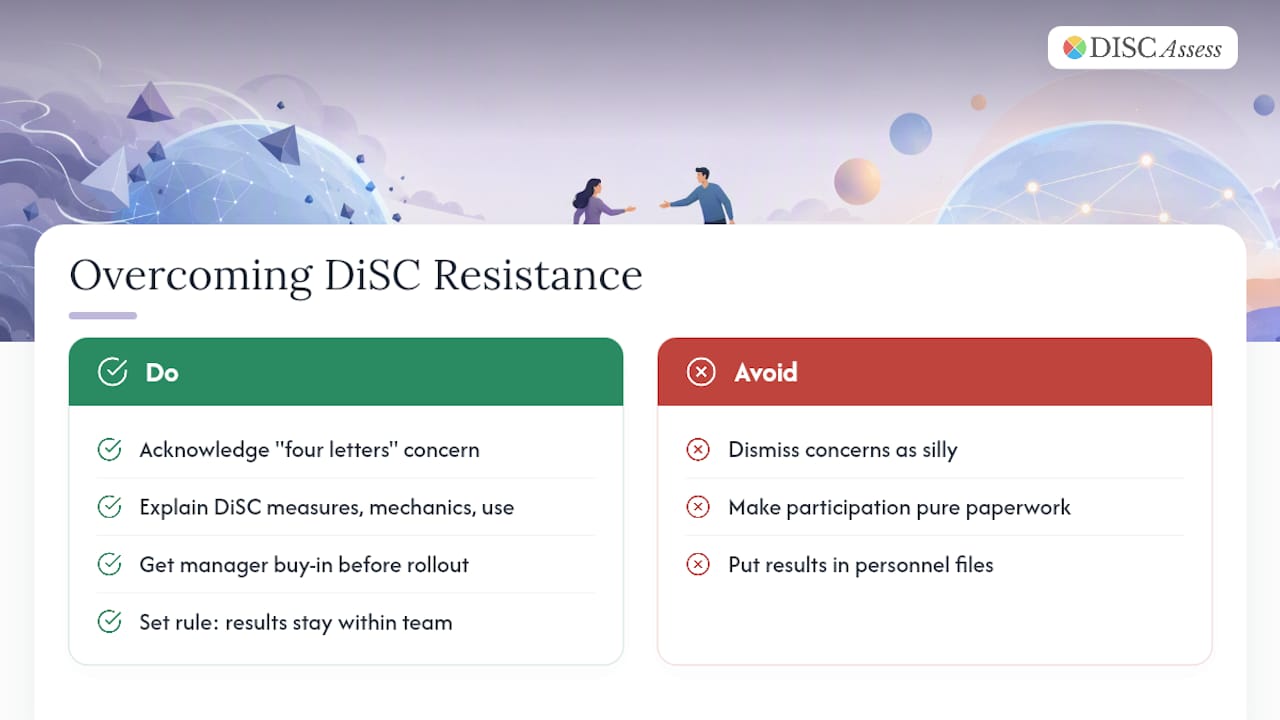
The most common resistance sounds like: "I don't want to be reduced to four letters." That reaction usually comes from a past experience with a shallow personality test, not from DiSC itself. Acknowledge the concern directly rather than dismissing it. Say plainly that DiSC describes tendencies, not fixed identity, and that most people show a blend of styles depending on the situation.
Skeptics, often high-C team members, want evidence before participation. Give them the mechanics: how the assessment works, what the report measures, and how the data will be used. Vague reassurance fuels more suspicion than a straight answer does.
Watch for the manager who treats the session as mandatory paperwork. Preparing managers ahead with strategies to reduce stress ties directly into best practices for cutting workplace mental health stigma and improving psychological safety. If leadership phones in their own participation, the team notices immediately and disengages to match. Fix this before the rollout starts, not after, by getting explicit manager buy-in during the pilot phase.
Privacy concerns surface fast, particularly in teams with a history of results being used against people. Set the ground rule early: results stay within the team for communication purposes and never touch a personnel file.
The slowest teams to warm up are usually the ones who need it most. A team heavy on S and C styles may take longer to open up in a group discussion than a D and i heavy team, but the eventual insight often runs deeper once trust builds. Give quieter teams more processing time between the individual debrief and the group session rather than rushing straight from one to the other.
How Should You Adjust DiSC for Different Team Cultures and Remote Teams?
A sales team steeped in fast talk and quick decisions needs a different pace than an engineering team built around deep focus and written communication. Match your activity choices to the team's existing rhythm instead of forcing a generic template onto every group.
For a fast-moving, D and i heavy culture, keep the introduction brief and action-oriented. Skip long theoretical explanations and get straight to the team map and commitments.
For a detail-oriented, C and S heavy culture common in finance, engineering, or compliance teams, give people the report in advance so they can process privately before discussing it out loud. Springing a group discussion on a room full of high-C personalities without prep time tends to produce silence, not insight.
Remote and hybrid teams need the same four-phase structure, adapted for the screen. Replace the physical DiSC Bingo card with a shared digital board in a tool like Miro or Microsoft Whiteboard. Run the team mapping exercise in breakout rooms of three or four so quieter styles get more airtime than they would in one large call. Record the group debrief session for anyone in a different time zone, and build in an asynchronous written reflection step, since some styles, particularly high-C and high-S, process better in writing than out loud on camera.
Faith-based or mission-driven organizations often benefit from framing DiSC through a growth and stewardship lens rather than a corporate performance lens, connecting behavioral awareness to how the team serves its shared purpose.
How Do You Measure Whether DiSC Actually Improved Your Team?
Skip the generic satisfaction survey. "Did you enjoy the workshop?" tells you nothing about whether behavior changed three months later. Track specific, observable behaviors instead: meeting effectiveness, handoff clarity between roles, and decision speed on recurring tasks. A measurement approach built around concrete behaviors rather than general sentiment gives leaders something they can actually act on.
Set your baseline before the pilot starts. How long do decisions currently take in a typical team meeting? How often do handoffs between departments require rework because expectations were unclear? Write these down before anyone sees a DiSC report so you have something real to compare against later.
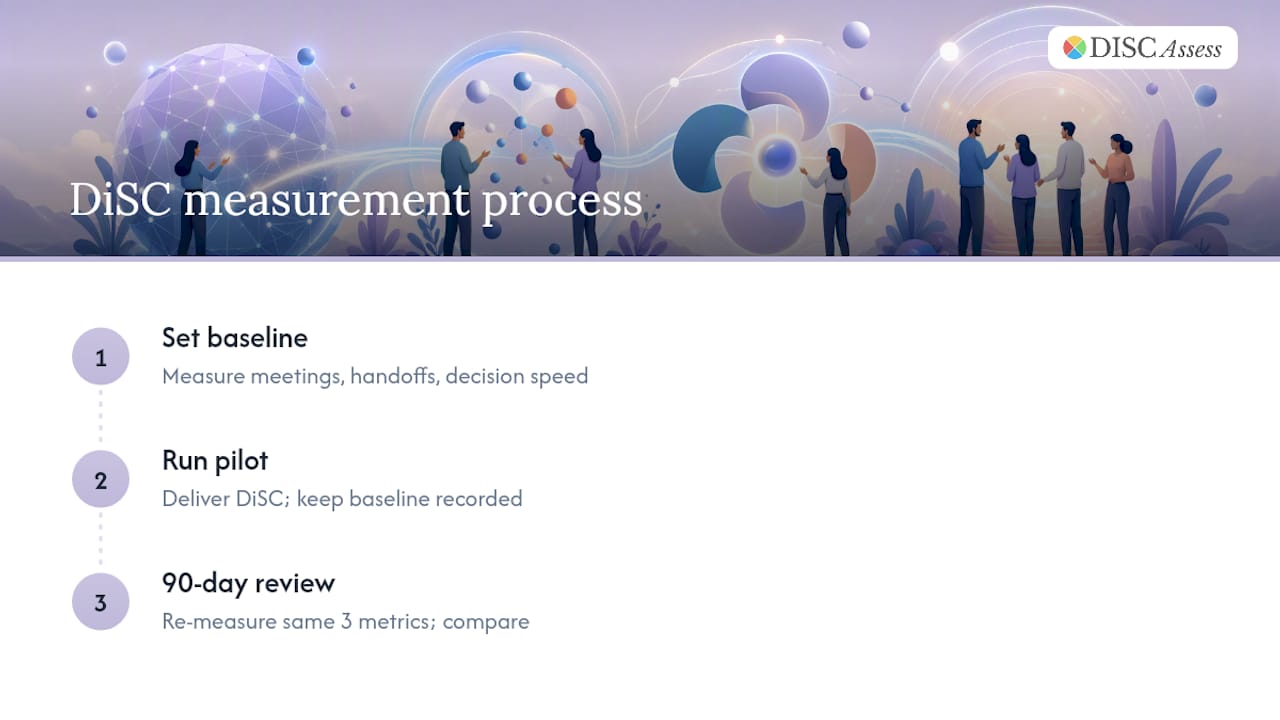
Revisit the same three or four metrics at the 90-day commitments review. Did meetings run shorter because people stopped talking past each other? Did the number of clarifying follow-up emails after a handoff go down? These are the signals that tell you the framework moved from insight to habit.
Business and organizational behavior programs, including resources published through Michigan State University, consistently frame communication assessments as tools that only prove their value when tied to observable team outcomes, not standalone scores. Treat the DiSC report itself as a starting point for measurement, never the finish line.
What Confidentiality Rules Should Govern Shared DiSC Results?
Set the confidentiality expectations before a single assessment goes out, not after someone feels exposed by a result shared without warning. Tell the team exactly what will be shared, with whom, and why.
Individual reports belong to the individual first. Whether someone shares their full report with the team or just a summary of their style should be their choice, not a mandate. Most people willingly share once they see colleagues doing the same, but forcing disclosure on day one creates resentment that undermines the entire rollout.
The group map is different from the individual report. Sharing an aggregated team map, showing the distribution of styles without over-emphasizing any one person's specific answers, gives the team useful insight without turning into a public breakdown of anyone's private results.
Keep DiSC data out of personnel files entirely. Results should live with the individual and, if shared, with the immediate team for communication purposes only. If your organization uses HR software or performance management systems, do not upload DiSC reports into either one. A resource on DiSC and hiring practices lays out why mixing behavioral assessment data with employment decisions creates both a trust problem and a legal exposure problem.
For remote teams sharing results over shared drives or messaging platforms, restrict access to the immediate team and delete broader distribution lists once the workshop cycle ends.
What a Facilitator Actually Sees in the First 90 Days
The pattern repeats across most rollouts: skepticism from one or two managers in week one, followed by a shift once they see their own report and recognize themselves in it. Month one usually produces a few quick wins, mostly around meeting pacing and email tone. Month three is where real change shows, once commitments from the team charter get tested against an actual conflict. Give it the full 90 days before judging whether it worked.
— Tres
How DISC Assess Can Help You Start This Week
A DISC assessment platform can support the rollout plan above, providing tools for each phase. The Starter Group Package covers a pilot group at a size most managers can actually facilitate without outside help. Once your pilot proves out and you are ready for wider rollout, the Admin Account gives you ongoing access to manage assessment credits, track completions, and generate reports as new team members come on board.
For teams that want a deeper facilitated debrief instead of running it solo, the Custom Group Report with Video Analysis walks your group through their combined map with narrated insight instead of a static PDF. And if your team prefers a guided session over self-facilitation entirely, live group training puts a facilitator in the room, virtual or in person, so you are not learning the framework and teaching it at the same time. Book a demo of the admin portal this week and map your pilot group before your next team meeting.
Sources
For deeper dives into the specific techniques referenced above, the DISC activities guide from Success covers additional exercise variations, Disctest's team building framework details the four-stage facilitation sequence, and Maximum Potential's guide explains DiSC's proper scope and limits.
FAQ
What Does DiSC Mean in Leadership?
In leadership contexts, DiSC identifies a leader's default behavioral tendencies, such as a D leader's bias toward speed and directness or an S leader's focus on stability and support, so they can adjust their approach to fit their team rather than lead on instinct alone.
Can You Give Examples of DiSC Questions?
DiSC assessments typically present forced-choice statements like rating how much a phrase such as "I prefer quick decisions over long discussion" or "I like having clear, detailed instructions" describes you, rather than open-ended personality questions.
What DiSC Type Are Most CEOs?
Executive populations tend to show a higher concentration of D and C styles, reflecting a bias toward decisive action and analytical rigor, though leadership success shows up across all four styles depending on the organization and role.
How Long Does It Take to Introduce DiSC to a Team?
A basic pilot runs two to four weeks from assessment to team workshop, with each person completing a 15-minute assessment followed by a 60 to 90 minute debrief before the full team session.
Should DiSC Results Be Shared With the Whole Team?
Individual reports should stay optional to share, but an aggregated team map showing the group's style distribution can be shared safely without exposing anyone's specific answers.