

A DISC assessment maps your natural behavioral tendencies across four dimensions — Dominance, Influence, Steadiness, and Conscientiousness — and shows which tendencies are your greatest strengths and which are areas ready for growth. Understanding how DISC identifies personal strengths and weaknesses starts with reading your full profile, not just your highest letter.
Here is what a complete DISC result reveals:
- Dominant score: your most natural behavioral mode and the strengths it produces
- Secondary score: the trait that modifies and shapes how your dominant style shows up in practice
- Natural vs. adapted graphs: your instinctive style versus how you adjust under pressure or role demands
- Low-score areas: less-preferred modes that often signal development opportunities, not deficiencies
The most important habit to build from day one: read the pattern, not a single letter. A D+C combination behaves very differently from a D+I, even though both share a high Dominance score.
Table of Contents
- How does a DISC assessment work, and what does the report show?
- What high and low scores mean for each DISC trait
- Why do trait combinations change what your DISC profile means?
- How do you turn your DISC results into a development plan?
- What DISC does not measure, and where interpretation goes wrong
- How long does it take, and what does it cost?
- What are the practical next steps after getting your results?
- Key Takeaways
- Why getting DISC interpretation right is worth the effort
- Discassess makes it easy to start right now
- Where to learn more
How does a DISC assessment work, and what does the report show?
Most online DISC assessments present between 20 and 75 statements that you rate by how well each describes you, and typical completion time is 10–15 minutes. Your responses are scored across the four dimensions and plotted into two graphs: a natural graph reflecting your instinctive style and an adapted graph reflecting how you adjust to your current environment.
| Report Element | What It Reveals |
|---|---|
| Dominant/secondary scores | Your primary behavioral strengths and the traits that refine them |
| Natural graph | How you behave when relaxed and in your element |
| Adapted graph | How you modify behavior under pressure or role expectations |
| Behavioral narrative | Written descriptions of likely strengths and cautions |
| Strength/caution callouts | Specific behaviors to leverage or watch |
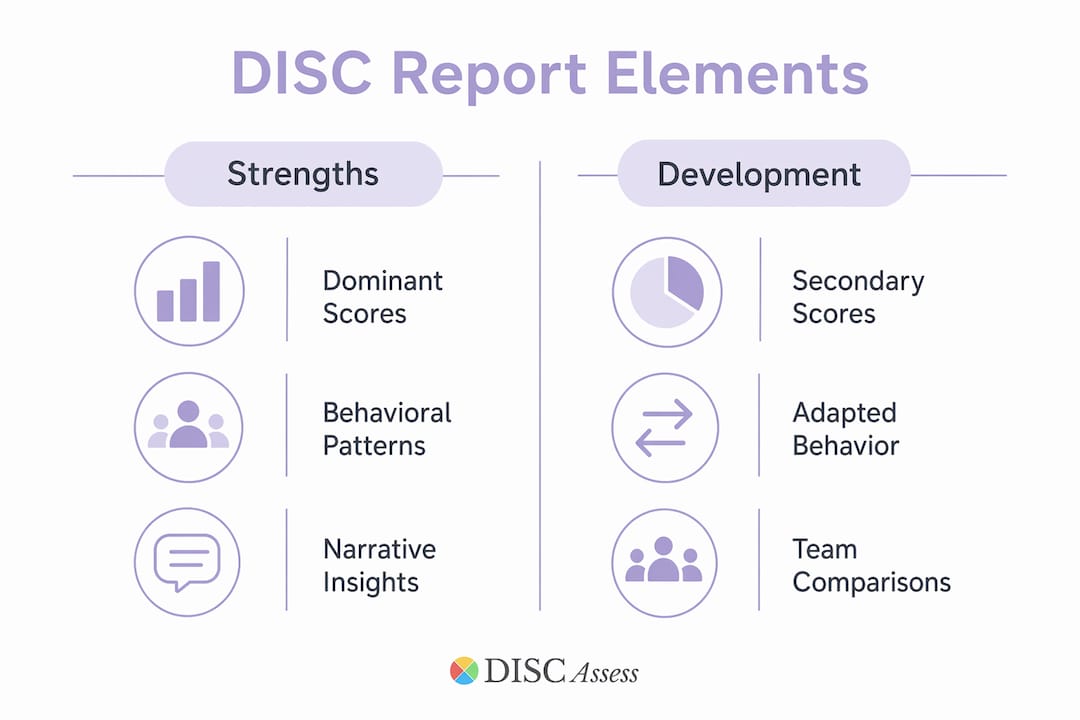
Paid detailed reports typically add expanded narratives, team comparison tools, and natural vs. adapted analytics that make the strength-and-weakness picture much clearer than a basic score summary.
Pro Tip: Answer each statement based on how you actually behave, not how you wish you behaved or how your role requires you to act. Honest responses produce the most useful profile.
What high and low scores mean for each DISC trait
No DISC style is superior. Each dimension carries genuine strengths and predictable development areas that surface when a trait is overextended or underused.

Dominance (D)
Direct, decisive, and results-focused. High-D individuals drive toward goals and handle conflict head-on.
- Strengths: decisive under pressure, strong initiative, clear goal focus
- Development areas: can overlook others' feelings, may rush decisions, tends toward impatience
Influence (I)
Enthusiastic, persuasive, and people-oriented. High-I individuals energize teams and build relationships quickly.
- Strengths: natural communicator, motivates others, thrives in collaborative settings
- Development areas: may avoid difficult conversations, can lose focus on details, sometimes over-promises
Steadiness (S)
Reliable, patient, and team-centered. High-S individuals create stability and listen deeply.
- Strengths: consistent follow-through, empathetic listener, calming presence in conflict
- Development areas: resists change, may avoid asserting needs, can struggle with urgent pivots
Conscientiousness (C)
Analytical, precise, and quality-driven. High-C individuals set high standards and think systematically.
- Strengths: thorough analysis, strong attention to detail, disciplined planning
- Development areas: can over-analyze before acting, may appear distant, sometimes struggles to delegate
Low scores in any dimension simply mean those behaviors are less natural for you. A low C score does not mean you are careless; it means precision-heavy tasks may require more intentional effort. That distinction matters when building a personal development plan for leadership.
Why do trait combinations change what your DISC profile means?
A full DISC profile usually shows multiple scores, and the combination explains behavior more accurately than any single dominant letter alone. Two brief examples show why this matters in practice:
- D+C profile: decisive and analytical. Strengths include solving complex problems quickly and maintaining quality control. The likely blind spot is people management — this combination can come across as cold or overly critical when under pressure.
- I+S profile: warm, persuasive, and steady. Strengths include building trust and sustaining team morale. The development area is often urgency — this combination may avoid conflict or delay hard decisions to preserve harmony.
Your report's behavioral wheel or graph shows where your scores plot relative to the center. Scores plotted far from the center indicate high-intensity traits; those near the center suggest more flexible, moderate tendencies. Both have value depending on the role and context.
This interaction principle is why DISC for workplace teams focuses on profile combinations rather than single-letter labels when assigning roles or addressing conflict.
How do you turn your DISC results into a development plan?
DISC supports personal leadership growth best when results feed a structured, time-bound plan rather than sitting as a label on a shelf.
- Read your dominant and secondary scores. Note which dimension scores highest and which is second; that pairing is your behavioral signature.
- Compare natural vs. adapted graphs. A large gap between the two often signals stress or role misalignment worth addressing.
- Identify 2–3 behavioral strengths from your report's narrative section that you can actively use more in your current role.
- Name 1–2 development areas tied to specific behaviors, not vague traits (e.g., "ask one clarifying question before responding" rather than "be more patient").
- Write SMART steps for each development area: Specific, Measurable, Achievable, Relevant, and Time-bound.
- Schedule a 6-week review to check whether your adapted graph has shifted and whether the behaviors feel more natural.
Compact 6-week template:
- Weeks 1–2: Read your full report; highlight two strengths and one development area. Practice one strength deliberately each day.
- Weeks 3–4: Focus on the development area. Set a micro-goal for each workday (e.g., a high-D practicing active listening in one meeting per day).
- Weeks 5–6: Gather informal feedback from a trusted colleague. Reflect on whether the adapted graph still shows the same gap.
A high-I professional working on follow-through might commit to sending a written summary after every meeting. A high-C individual building influence skills might practice sharing an opinion before asking for more data. Small, consistent behavior shifts compound over time.
What DISC does not measure, and where interpretation goes wrong
DISC is a behavioral tendency tool, not a clinical instrument. Keeping that boundary clear protects both individuals and organizations.
What DISC does not measure:
- Intelligence or cognitive ability
- Emotional health or clinical diagnoses
- Core values, motivations, or spiritual maturity
- Fixed personality traits that cannot change
Common interpretation pitfalls:
- Treating a single letter as a permanent identity ("I'm just a high D — I can't help being blunt")
- Using DISC as the sole criterion in hiring without pairing it with interviews, skills tests, or experience review
- Misreading the adapted graph as the "real" profile when it may simply reflect a stressful season
- Assuming a low score means weakness rather than a less-preferred mode
For workplace use, storing and sharing DISC results requires clear consent protocols. Results should be treated as development data, not performance records, and access should be limited to those directly supporting the individual's growth. When findings feel off, validate them with feedback from colleagues, performance evidence, or a certified practitioner before acting on them.
How long does it take, and what does it cost?
Most assessments complete in 10–15 minutes. Report depth and price vary by tier:
- Basic/free reports: a score summary with brief trait descriptions; useful for orientation but limited for development planning
- Individual paid reports: full behavioral narratives, natural and adapted graphs, and strength/caution callouts; typically a one-time purchase
- Group packages: bulk assessments with an admin portal for comparing profiles across a team
- Unlimited memberships: organization-wide access for ongoing hiring, training, and coaching cycles
Paid features that deliver the deepest strength-and-weakness evidence include expanded behavioral narratives, natural vs. adapted analytics, and team comparison dashboards. The Classic DISC Personality Assessment from Discassess is a strong individual starting point, while the Christian DISC® Spiritual Assessment adds a faith-based layer for individuals and organizations who want to connect behavioral tendencies to spiritual formation and growth.
What are the practical next steps after getting your results?
Micro-level (daily):
- Practice one strength behavior intentionally each morning
- Journal one moment where your natural style helped or hindered you
Medium-level (weekly/monthly):
- Adjust your role responsibilities to lean into your top strengths where possible
- Run a brief DISC-informed conversation with a teammate to improve communication; inclusive team-building practices can help you extend those insights to diverse colleagues
Longer-term:
- Engage a certified DISC practitioner or coach for deeper interpretation and accountability
- Use team-building effectiveness metrics to track whether DISC-informed changes are producing measurable results
When to self-interpret vs. seek support:
- Self-interpret when your report narrative resonates clearly and you have a specific development goal in mind.
- Use a platform like Discassess when you need group comparison tools, admin features, or structured report tiers.
- Hire a certified practitioner when results feel confusing, when high-stakes decisions (hiring, promotion) are involved, or when a team needs facilitated interpretation.
Re-check your adapted graph every 3–6 months. Significant life or role changes often shift it, and tracking that movement is one of the clearest signals of genuine behavioral growth.
Key Takeaways
DISC reveals personal strengths and weaknesses through behavioral patterns, not single letters, and those insights become most useful when paired with a structured, time-bound development plan.
| Point | Details |
|---|---|
| Read combinations, not letters | Primary and secondary scores together explain behavior more accurately than any single dimension alone. |
| Natural vs. adapted gap | A large gap between the two graphs often signals stress or role misalignment worth addressing directly. |
| Low scores are development areas | A low score means a less-preferred mode, not a fixed deficiency; targeted practice can build those behaviors. |
| Use SMART steps | Tie each development area to a specific, measurable behavior change and review progress at six weeks. |
| Discassess as a starting point | Discassess offers individual, group, and faith-based assessments with instant reports and coach-backed resources for immediate use. |
Why getting DISC interpretation right is worth the effort
Most people take a DISC assessment, read their dominant letter, and stop there. That is a little like receiving a detailed map and only glancing at the legend. The real value of DISC is not the label; it is the conversation the results open between you and your own patterns of behavior.
What I find most encouraging is that DISC does not tell you who you are in some fixed, unchangeable sense. It shows you how you tend to show up, which means it also shows you where you have room to grow. That is a hopeful framing, especially for anyone who has ever felt stuck in a role that did not fit or frustrated by a recurring conflict they could not quite name. DISC gives that frustration a language, and language is the first step toward change.
Treat your DISC profile as a working document, not a verdict. Test its insights in real conversations, adjust your approach, and revisit your adapted graph as your circumstances evolve. Growth is rarely linear, but it is always possible.
Discassess makes it easy to start right now
If you are ready to move from curiosity to clarity, Discassess offers something most assessment platforms do not: instant, detailed reports at an accessible price point, backed by over a decade of counseling and coaching experience through Prism Counseling & Coaching.
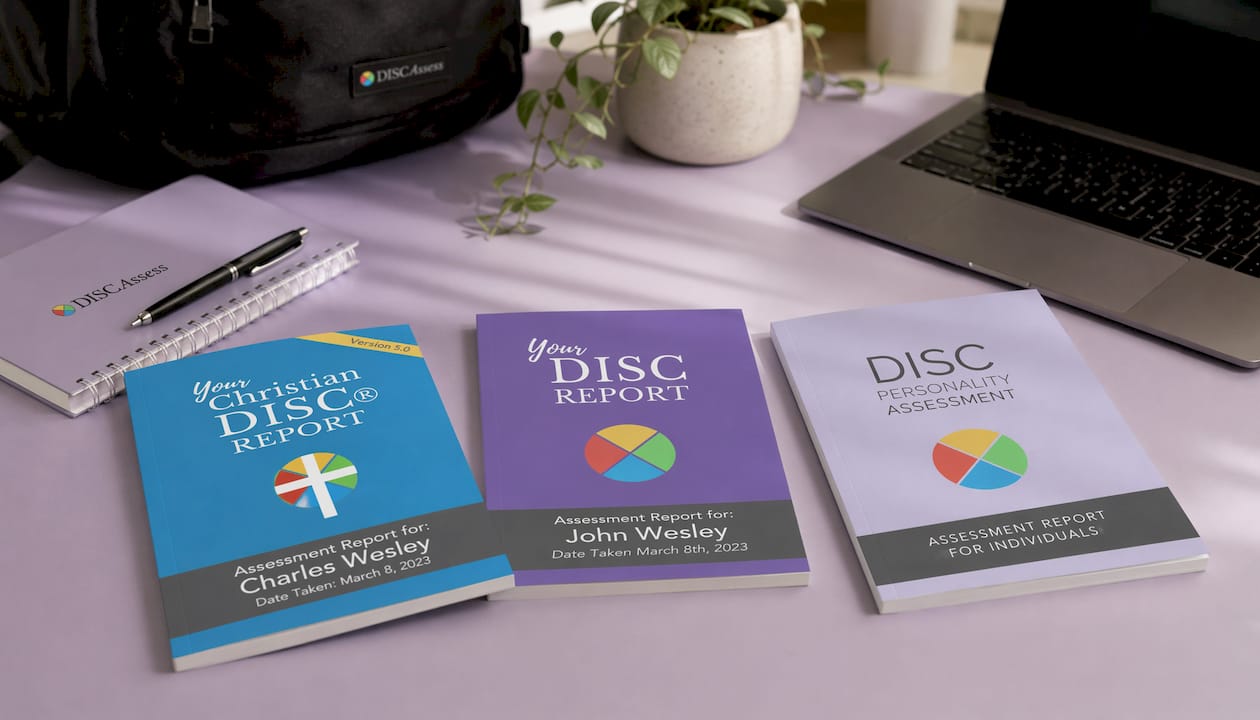
Whether you are an individual professional looking to understand your behavioral tendencies, a team leader who needs group comparison tools, or part of a faith community that wants to connect personality insights to spiritual growth, Discassess has a report designed for your situation. The Classic DISC Personality Assessment delivers a full natural and adapted graph with behavioral narratives in minutes. The Christian DISC® Spiritual Assessment weaves in faith-based reflection for individuals and organizations pursuing sanctification alongside self-awareness. Group packages include an admin portal, team comparison features, and downloadable resources that make it straightforward to run a development session without an HR department. Visit Discassess to choose the assessment that fits your next step and receive your report immediately.
Where to learn more
- Discassess platform: individual assessments, group packages, and unlimited memberships with instant reports
- Discassess blog: applied articles on DISC for leadership, teams, and personal growth
- DISC for workplace teams guide: manager-focused advice on using profiles for role fit and conflict resolution
- DISC in leadership coaching: when and how a certified coach deepens DISC interpretation
- VIA Character Strengths Survey: a complementary strengths inventory that takes 10–15 minutes and ranks your positive character traits; pairs well with DISC for a fuller development picture
- VIA strengths application resources: practical guidance on applying character strengths to increase confidence and wellbeing
- Discassess articles library: deeper reading on DISC applications across nonprofit, small business, and coaching contexts
Combining DISC with a strengths-based instrument like the VIA Survey gives you both a behavioral map and a values-anchored strengths inventory, which together produce a richer, more complete picture of who you are and how you grow.