

Yes, DISC can strengthen church teams when it is applied thoughtfully and paired with pastoral care, not used as a shortcut to label people. Used well, disc in ministry settings sharpens role fit, softens communication friction between volunteers, and gives leaders a shared language for resolving conflict before it festers. The key is roll out and follow up, not the assessment itself.
TL;DR:
- DISC assessments should be used as a tool for understanding behavior tendencies and role fit, not as a definitive measure of character or calling.
- Successful ministry application involves careful rollout with a clear process, including setting scope, collecting results, facilitating debriefs, and scheduling follow-ups.
- Results are most effective when integrated with existing spiritual gifts discussions and leadership development, never used as the sole basis for major decisions.
- Implementations benefit from faith-adapted tools, facilitator training, and follow-up coaching to ensure behavior change and role clarity.
- Starting with small groups or specific teams allows churches to introduce DISC gradually and assess impact before wider adoption.
Table of Contents
- What Is DISC, and How Does It Show Up in Ministry?
- Why DISC Matters in Ministry
- How to Use DISC in Ministry: A Step-by-Step Rollout
- Does DISC Conflict With a Biblical View of Identity?
- Ministry-Ready DISC Tools and Resources
- What Ministry Leaders Actually See When They Try This
- Getting Started With DISC in Your Church
- Sources
- FAQ
What Is DISC, and How Does It Show Up in Ministry?
DISC measures behavioral tendencies across four styles: Dominance (D), Influence (I), Steadiness (S), and Conscientiousness (C), a framework that traces back to psychologist William Moulton Marston in the 1920s. Marston's original work was on emotion and behavior, and later practitioners built the assessment tool churches use today.
In a ministry context, these styles show up in familiar ways. A high D might be the deacon who pushes a building project forward and gets frustrated with slow committee votes. A high I often thrives as a greeter or worship leader, energized by connection and public expression. High S volunteers are the steady hands in children's ministry and hospitality, the ones who show up every week without needing recognition. High C tends toward finance teams, sound booths, and anywhere accuracy matters more than applause.
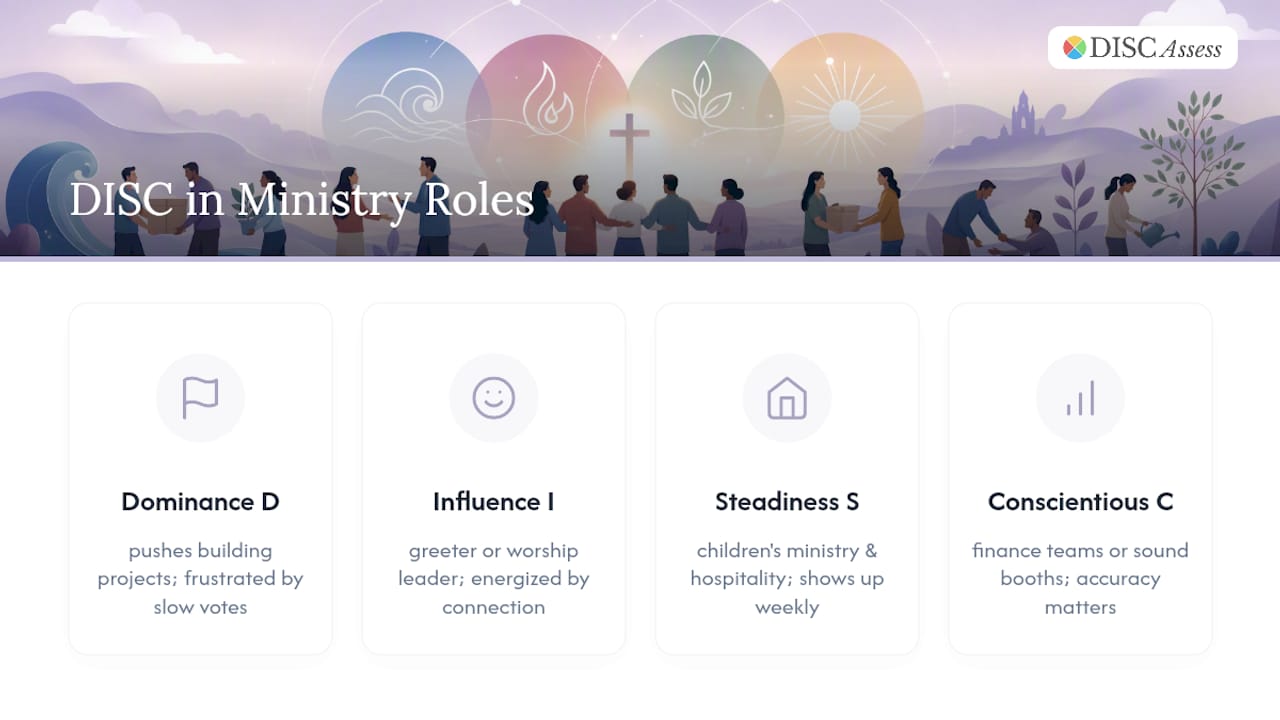
Most people carry a blend of two or three styles rather than one pure type, which is why a ministry disc model works best as a conversation starter, not a box to check.
Why DISC Matters in Ministry
The payoff of disc assessment in ministries comes down to four practical outcomes, and they compound over time. Ministry-focused guides consistently point to role alignment, clearer communication, and reduced conflict as the core benefits churches see when DISC is applied with intention.
- Role alignment: volunteers serve where their natural tendencies actually fit, instead of filling a gap because no one else raised a hand.
- Communication: a pastor learns to deliver correction to a high C in writing with specifics, while a high I might need the same message delivered warmly and in person.
- Conflict resolution: knowing that a tense exchange between a D and an S is often a style clash, not a character flaw, changes how leaders mediate.
- Leadership development: DISC gives elder boards and staff a common vocabulary for succession planning and for identifying who is ready for more responsibility.
Churches that treat these benefits of disc in church settings as a package, not a menu, tend to see the deepest change. Communication improvements alone rarely stick without the role clarity that gives people permission to serve differently.
How to Use DISC in Ministry: A Step-by-Step Rollout
A church disc workshop works best as a process with a beginning, middle, and follow-up, not a one-time event. Here is a sequence that fits most congregations, whether you are piloting with a single ministry team or rolling out across staff and volunteer boards.
- Choose your scope and get buy-in. Start with one team, a worship staff, a deacon board, or a children's ministry, rather than the whole church at once. Bring the idea to senior leadership first so the initiative has visible pastoral support.
- Set up assessments and a group admin structure. A group admin account lets you distribute assessments, track completion, and pull reports for the whole team in one place instead of chasing individual results.
- Distribute and collect results. Give people a realistic window, about a week, to complete their assessment without feeling rushed.
- Run a facilitated debrief workshop. Structure the session around self-read results first, then paired conversations, then a group role-mapping exercise, a format several church networks already use with success.
- Create "how to work with me" cards. Have each person summarize their style, their communication preference, and one thing that helps them do their best work. Post these where the team can reference them.
- Schedule follow-up coaching. Revisit the results in three to six months, a cadence ministry-focused guides recommend for measuring whether behavior actually changed.
Pro Tip: Do not let the workshop end without one concrete action step per person. "I will pause and ask a clarifying question before reacting" is more useful than a vague commitment to "communicate better."
Nonprofit and volunteer-heavy organizations follow a similar arc, and reviewing how volunteer teams apply DISC elsewhere can help you adapt the steps to your own congregation's rhythm.
Does DISC Conflict With a Biblical View of Identity?
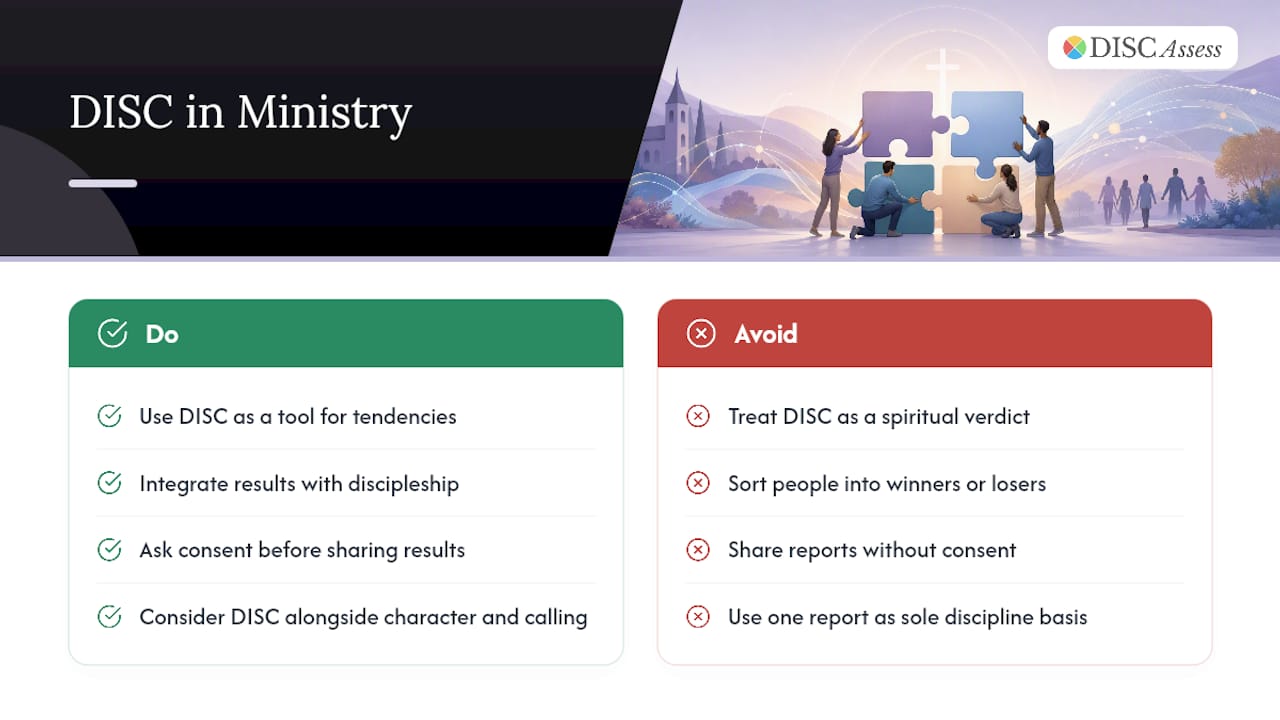
DISC works best in ministry when leaders treat it as a tool for understanding tendencies, not a spiritual verdict on someone's character or calling. A high D is not more "called" to leadership than a high S; a high I is not more spiritually mature than a high C. The four letters describe behavior, not the fruit of the Spirit.
The most effective churches integrate DISC results with existing discipleship and spiritual gifts conversations rather than replacing them. Christian DISC vendors design their materials specifically to connect personality insight with strengths-based service, which is a healthier frame than using results to sort people into winners and losers.
Two guardrails matter most. First, get consent before distributing anyone's results beyond the person themselves and their direct ministry leader. Second, never use a single DISC report as the sole basis for hiring, firing, or church discipline. It is one input among many, alongside character, calling, and community discernment.
Ministry-Ready DISC Tools and Resources
Rolling out disc communication styles for pastors goes faster when you are not building materials from scratch. Vendor pages built specifically for churches typically bundle three things: a faith-adapted assessment, an admin portal for group management, and printable workshop templates, a combination that Christian DISC providers design around ministry use rather than corporate HR.
For leaders preparing to teach or facilitate, a few resource types cover most needs:
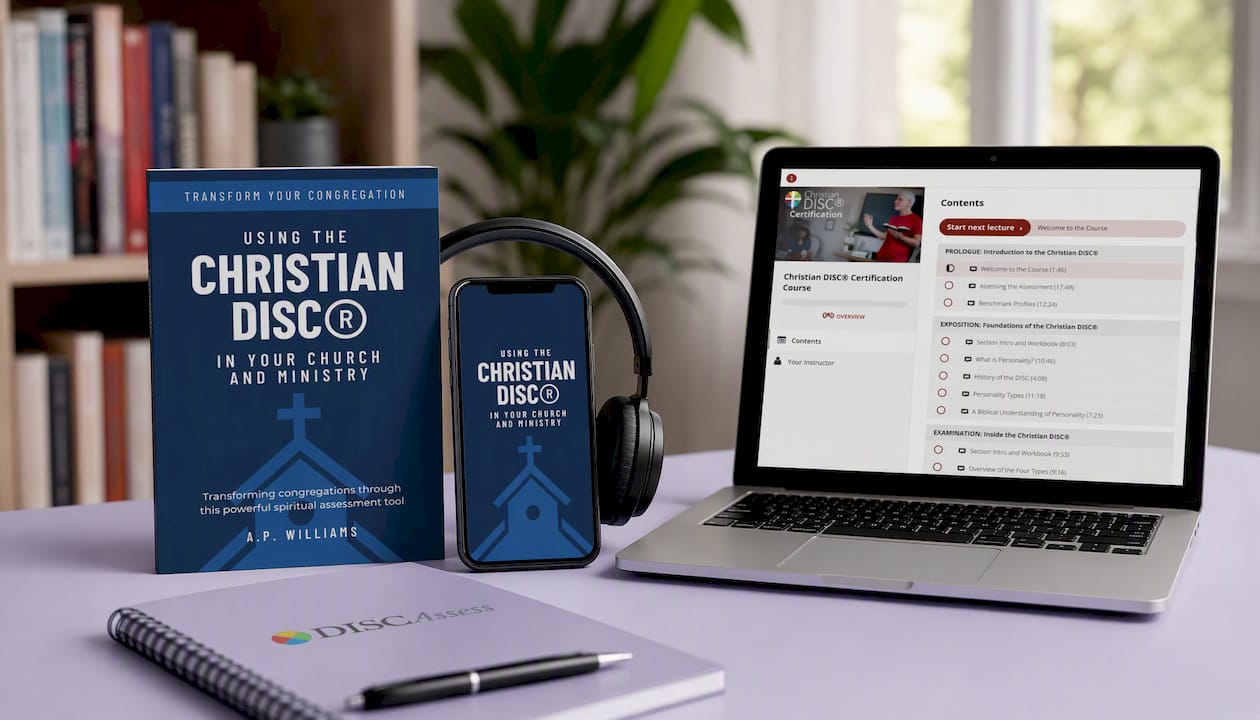
- Leader preparation materials, such as Using the Christian DISC® in Your Church and Ministry in paperback or as an audio book for leaders who prefer to listen while driving between visits.
- Facilitator training, through a Christian DISC® Certification Course for those who plan to run workshops repeatedly across ministries.
- Group administration tools, including admin portals that track team results and printable role-mapping templates for workshop days.
A typical workshop pairs a short teaching segment on the four styles with a paired-sharing exercise, then closes with each participant filling out a one-page "how to work with me" card to keep at their desk or serving station.
What Ministry Leaders Actually See When They Try This
The most consistent result reported across ministry settings is not dramatic personality change. It is clearer handoffs between leaders and steadier volunteer retention once people serve in roles that fit them. Denominational case studies describe DISC used across staff, boards, and auxiliaries to reduce relational fatigue that builds up when nobody understands why a colleague communicates the way they do.
— Tres
Getting Started With DISC in Your Church
Start small. A single-team pilot, your worship staff, your elder board, or your children's ministry volunteers, gives you a low-risk way to see how a church disc workshop lands before committing to a full rollout. There are DISC providers built for exactly this kind of ministry-sized step: no enterprise contracts, no HR department required, just assessments and group tools sized for church teams.
If you are testing the waters, an individual assessment is the simplest entry point for one leader or one difficult working relationship. Ready to bring a whole team along? A group admin account lets you distribute both the classic and Christian DISC® assessments and manage results from one dashboard. And if you plan to facilitate workshops regularly across ministries or a denomination, the Extended Pro Membership for facilitators is built for exactly that repeated use. Pick the option that matches where your team is today, and take the first step this week.
Sources
- DISC assessment — Wikipedia
- Using a DISC Assessment To Build Healthy Church Teams — Ministry Vitals
- A Case for DISC Assessments in the AME Church — The Christian Recorder
FAQ
What Are the 12 DISC Personality Types?
DISC is built on four primary styles, D, I, S, and C, but most frameworks describe twelve blended types that combine a dominant and secondary style, such as "D/I" or "S/C." These blends capture the reality that few people are a pure single type, which is why ministry role-mapping works best when it accounts for a person's top two styles rather than one label.
What Is the Rarest DISC Personality Type?
Pure single-style profiles are less common than blended types in most populations, and among the four core styles, D tends to appear least frequently in general population samples. Rarity is not the same as value. Every style contributes something a healthy ministry team needs.
How Do I Become DISC Certified for Ministry Use?
For church settings specifically, the Christian DISC® Certification Course trains facilitators to administer faith-adapted assessments and run workshops within a ministry context. Certification typically covers interpreting reports, running debrief sessions, and applying results ethically within a church's existing leadership structure.
Can DISC Replace Spiritual Gifts Assessments in a Church?
No, DISC measures behavioral style, not spiritual calling or gifting, so it should complement a spiritual gifts inventory rather than replace one. The strongest ministry applications use DISC to explain how someone serves and gifts assessments to explain where they serve.