

A DISC assessment is a behavioral tool that measures your natural tendencies across four dimensions, Dominance, Influence, Steadiness, and Conscientiousness, to help you communicate better and understand your team. Most people use it to sharpen self-awareness, reduce workplace friction, and build stronger relationships at work or in ministry. You can take a quick free version for personal insight or invest in a validated paid report when you need something more durable for a whole team.
TL;DR:
- Validated DISC reports are essential for team development, especially when used for hiring, leadership coaching, or strategic role alignment.
- The assessment typically takes 8 to 20 minutes, with free versions providing quick, basic insights suitable for personal curiosity or small groups.
- Sharing results transparently and adapting communication styles to individual DISC profiles can reduce workplace friction and foster stronger relationships.
- Group packages and offline assessments support larger teams and logistical needs, making implementation scalable and flexible for different settings.
- Using DISC as a conversation starter and maintaining trust through transparency enhances its effectiveness beyond labeling individuals.
Table of Contents
- What DISC Measures: Understanding the Four Dimensions
- How a DISC Assessment Works, from Questionnaire to Report
- Why a DISC Personality Test Pays Off at Work and in Life
- Free vs. Validated DISC Tests: Matching the Tool to the Goal
- Turning DISC Results Into Real Team Growth
- Why This Guide Reflects Real DISC Practice
- Which DISC Assess Product Fits Your Next Step
- A Word on Using DISC Well
- Sources
- FAQ
What DISC Measures: Understanding the Four Dimensions
DISC organizes human behavior into four core dimensions, and every profile is some blend of the four. Understanding them is the first step toward reading your own results, or anyone else's, with real insight rather than guesswork.
- Dominance (D): Direct, results driven, comfortable with challenge and quick decisions.
- Influence (I): Outgoing, persuasive, energized by people and enthusiasm.
- Steadiness (S): Patient, dependable, values harmony and steady progress.
- Conscientiousness (C): Analytical, detail oriented, driven by accuracy and structure.
Few people fit neatly into just one box. Most profiles show a primary style paired with a secondary influence, like a "DC" who leads decisively but insists on getting the details right, or an "SI" who values relationships while keeping the peace. Reports also show intensity, how strongly a trait shows up, not just which trait dominates. This matters because two "D" personalities can lead very differently depending on how strong that dominance score runs.
One caution worth naming plainly: DISC measures observable behavior and preferences, not clinical traits, and it was never built as a diagnostic instrument. Think of it as a map of tendencies, not a verdict on character. The value comes from what you do with the map, not the map itself.
How a DISC Assessment Works, from Questionnaire to Report
Taking a DISC assessment is simple by design, and that simplicity is part of why it has spread so widely through churches, nonprofits, and small offices. Here's the typical path from start to finish.
- You answer a short questionnaire. Most formats run 20 to 24 items, though some quick screens use as few as 12. Questions are usually forced choice ("pick the word that describes you best") or Likert scale ("rate how strongly this applies").
- You complete it fast. Expect about 8 to 20 minutes for a validated version, often less for a simple free version.
- You receive a report, often instantly. Basic free tools generate results the moment you finish. Validated paid reports may take a bit longer to compile but deliver far more depth.
- You read a summary of your primary style and blend. Good reports translate raw scores into plain language: how you communicate, what motivates you, what stresses you out.
- You may get a comparison report. For teams, this overlays multiple profiles side by side, which is where DISC starts paying off for group dynamics rather than just individual insight.
Why a DISC Personality Test Pays Off at Work and in Life
The real payoff of a DISC personality test shows up the first time you catch yourself adjusting how you talk to someone instead of just reacting to them. That shift, from reaction to intention, is what turns self-awareness into a practical skill rather than a personality trivia fact.
On a personal level, understanding your own DISC type helps you notice patterns you have probably sensed for years but never named. A high "D" might realize why patience feels like a constant discipline. A high "S" might finally understand why conflict drains them so much. That kind of clarity is the seed of real emotional growth, the kind Scripture calls us toward as we grow in patience, gentleness, and self-control.
DISC becomes even more valuable once you apply it to how you speak to others:
- Give a "D" the bottom line first, then the details if they ask.
- Give an "I" room to talk it out before locking in a decision.
- Give an "S" time to process change instead of springing it on them.
- Give a "C" the data and the reasoning, not just the conclusion.
Adapting your delivery to someone's style rather than defaulting to your own is one of the most practical communication upgrades a team can make.
For teams, the applications multiply: aligning roles with natural strengths, easing new hires into a group faster, cutting down repeat conflicts, and giving coaches or team leads a shared language for growth conversations. Our guide to leadership development coaching walks through how to apply this in one-on-one settings.
Pro Tip: Share your own DISC results with your team first. It signals that this is a tool for mutual understanding, not a way to label people.
Free vs. Validated DISC Tests: Matching the Tool to the Goal
A free DISC test and a validated paid version are not competing for the same job, and knowing which one you actually need saves both time and money.
Free tests deliver a fast, useful estimate, typically in ten minutes or less, and work well when you are personally curious, introducing a friend or small group to the concept, or just want a taste before committing further. Discassess offers exactly this kind of entry point through its free DISC assessment.
Validated paid reports earn their cost when the stakes rise. If you are rolling DISC out across a staff team, using it to inform hiring conversations, or building a leadership development track, you need the research backing, reliability, and team dashboards that come with a validated product. This is also where facilitated coaching adds real weight; the University of Iowa's leadership program, for example, pairs its assessment with an individualized report review and an optional coaching session for a fee that varies by program, such as $95 at one university program.
Here is how the goal maps to the product:
- Already set up but need more capacity as your group grows? Assessment credits refill your account without starting a new package from scratch.
Turning DISC Results Into Real Team Growth
Results only matter once you actually use them, and that starts with consent. Always tell your team why you're introducing DISC and how the results will be used before anyone takes the test; transparency about intent is what keeps this a trust-building exercise instead of a source of anxiety.
From there, a simple five-step rollout works for almost any size group:
- Prepare by explaining the purpose and inviting questions.
- Share results in a low-pressure setting, not a public callout.
- Adapt communication norms based on the styles present.
- Map roles and responsibilities against natural strengths.
- Follow up a few weeks later to see what's actually changed.
Two activities make this concrete fast. First, have everyone write a one sentence communication preference card ("I do best with direct, short updates") and post it visibly. Second, run a 30-minute team mapping session where you plot everyone's primary style on a whiteboard and talk through where overlaps and gaps might cause friction.
Pro Tip: Revisit the team map every six months. Roles shift, stress changes behavior, and a stale map does more harm than no map at all.
Why This Guide Reflects Real DISC Practice
This guide draws on established behavioral science and practical experience from a DISC provider and coaching group with extensive background in the coaching and counseling field. The platform offers group admin tools, detailed instant reports, and flexible buying options, including group packages, offline assessment bundles, and assessment credits aimed to support implementation for small businesses, nonprofits, and ministry teams. For deeper implementation help, see our practical guide to DISC for leadership development or our notes on using DISC with volunteer teams.
Which DISC Assess Product Fits Your Next Step
If you're leading a full team through this process for the first time, the DISC Group Package gives you the admin account and credits in one bundle, so you're not stitching tools together to manage a group rollout.
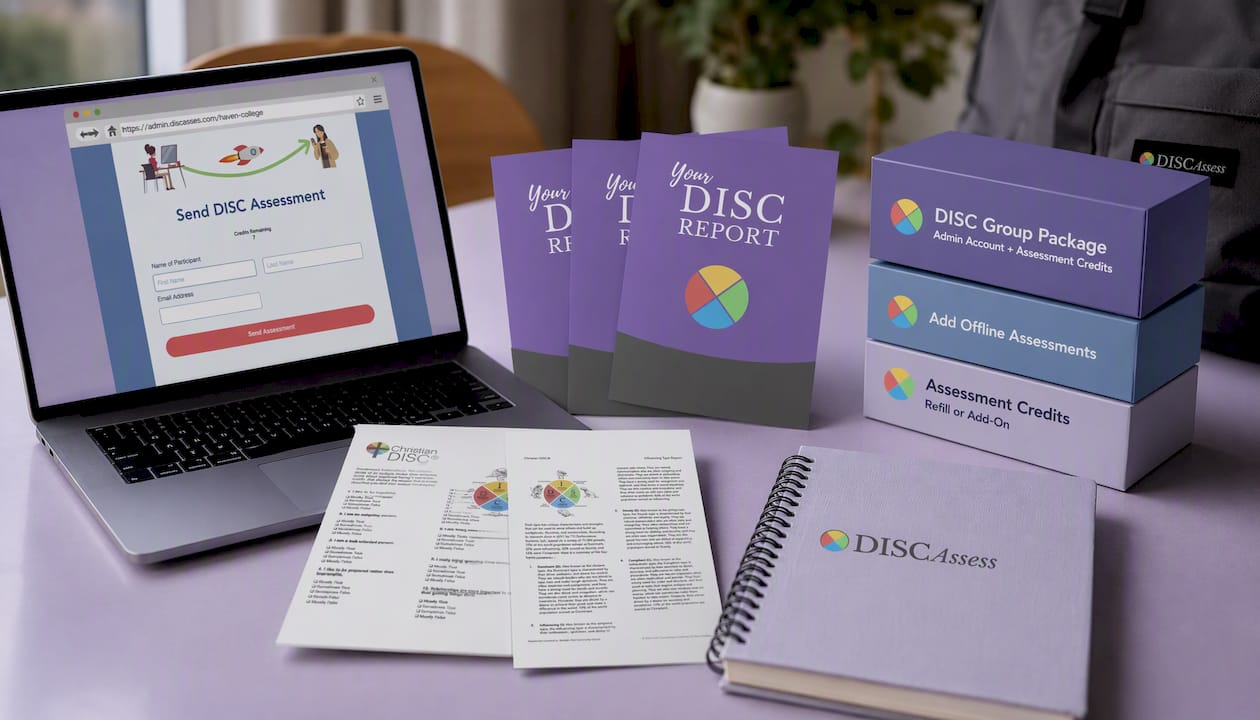
Running an in-person gathering, a retreat, or a training day where Wi-Fi is unreliable? Offline assessment bundles let you administer paper assessments without depending on a live connection. And if your group is already up and running but growing, assessment credits let you add capacity without rebuilding your setup. Teams working through recurring friction often pair DISC insight with focused conflict resolution strategies to translate behavioral awareness into fewer repeat disagreements. Whatever stage you're at, start with the free DISC assessment to see how the reports read before committing to a bigger rollout.
A Word on Using DISC Well
DISC works best as a conversation starter, never a verdict. I'd rather see a team use it imperfectly with honesty than perfectly with secrecy. Pair it with real listening, get consent before you assess anyone, and lean on Discassess resources or a guided rollout when you want support putting it into practice.
— Tres
Sources
- Benefits of DiSC Personality Tests | US Chamber of Commerce
- Free DISC Assessment, Instant Results for Individuals and Teams | Cloverleaf
FAQ
What DISC type is Elon Musk?
There's no verified, official DISC report for Musk, so any answer floating around online is speculation. Public behavior often gets read as a strong D with I influence, but that's an outside observation, not a validated result.
What was Donald Trump's DISC personality type?
Like Musk, there's no confirmed, published DISC assessment for Trump. Commentary suggesting a dominant D style is informal speculation, not a validated report.
Which DISC personality is rarest?
Reliable population data on exact rarity isn't publicly established across DISC providers, so be skeptical of any source claiming a precise rarity ranking. What's clear is that pure single-style profiles are less common than blended ones.
What are the 12 DISC personality types?
Different DISC publishers define secondary blends differently, so there's no single universal list of 12 types. Most models describe a primary style plus a secondary influence, which is why report language varies between providers like Discassess and others.
How long does a DISC assessment take?
Most validated versions take 8 to 20 minutes, while free quick tests often finish in 10 minutes or less.
Can DISC results be used for hiring decisions?
DISC should inform hiring conversations, not decide them outright, since it's not a clinical diagnostic tool and works best alongside interviews and other assessments.