
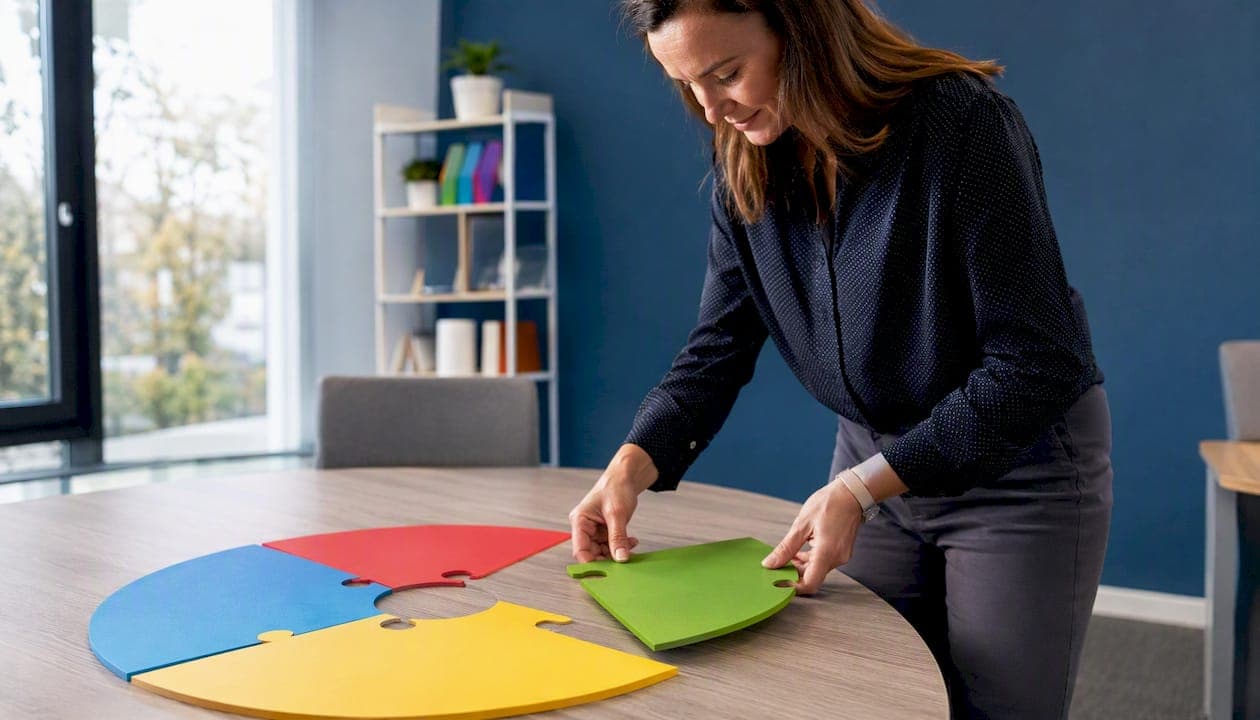
A DISC 360 is a multi-rater assessment that layers structured feedback from managers, peers, and direct reports on top of an individual's own DISC profile, revealing the gap between how you see yourself and how others experience you. That gap is where real growth begins.
What you can expect from a DISC 360:
- Uncover leadership blind spots and perception gaps that a self-only DISC profile cannot surface
- Build targeted development priorities backed by behavioral evidence from the people who work with you daily
This guide walks you through the full process: how a DISC 360 works, what the report shows, how to administer one, how to interpret results, and how Discassess makes it practical for small businesses and teams.
Key Takeaways
A DISC 360 produces its greatest value when paired with a structured debrief, a minimum of 5–6 raters across multiple groups, and at least one development goal that is specific enough to measure within 90 days.
| Point | Details |
|---|---|
| Minimum rater count | Use at least 5–6 total raters across groups to protect anonymity and produce reliable gap data. |
| Start with the gaps | Prioritize the largest divergences between self-scores and rater group averages before reading anything else. |
| Debrief is non-negotiable | A 360 report without a coached or facilitated debrief rarely produces lasting behavioral change. |
| Right tool for the goal | Choose a self-only DISC for foundational awareness; choose DISC 360 when multi-stakeholder behavioral change is the objective. |
| Discassess for small teams | Discassess offers individual assessments, group credit packages, and live training add-ons sized for small businesses and nonprofits. |
Table of Contents
- What is a DISC 360, and how does it differ from a standard DISC?
- How a DISC 360 assessment actually works, step by step
- The real benefits of DISC 360 feedback, and when it matters most
- Who should use a DISC 360, and when is it the right choice?
- What you will find inside a DISC 360 report
- Practical administration: raters, timelines, and pricing
- How to interpret your DISC 360 results and build a development plan
- What DISC 360 can and cannot tell you: validity, confidentiality, and limits
- How Discassess makes DISC 360 practical for small businesses
- Sources
What is a DISC 360, and how does it differ from a standard DISC?
A standard DISC assessment captures one perspective: yours. You answer a series of behavioral questions, and the report reflects your self-perception across the four DISC dimensions: Dominance, Influence, Steadiness, and Conscientiousness. That is genuinely useful, but it is also incomplete.
A DISC 360, sometimes called a 360 degree DISC, adds a second layer. Raters from your professional circle, typically your manager, peers, and direct reports, complete a parallel behavioral questionnaire about you. Their aggregated responses are then compared against your self-report. The result is a perception gap analysis: where your self-view aligns with others' experience, and where it diverges.
Self-only DISC vs. DISC 360 at a glance:
| Dimension | Self-Only DISC | DISC 360 |
|---|---|---|
| Data source | Participant only | Participant + multiple rater groups |
| Bias risk | Self-serving bias possible | Aggregated feedback reduces individual bias |
| Insight depth | Behavioral tendencies | Behavioral tendencies + perception gaps |
| Development focus | General self-awareness | Targeted, evidence-based development |
| Typical output | Profile + narrative report | Gap scores, rater group charts, narrative comments, action suggestions |
The 360 concept borrows from multi-rater feedback methodology: feedback arrives from all directions around the participant, hence the name. Anonymity is standard practice. Rater responses are aggregated so no single person's input is identifiable, which encourages honesty and reduces social pressure.
How a DISC 360 assessment actually works, step by step
The process is more structured than a standard assessment, but it is not complicated once you understand the sequence.
- Identify the participant. Confirm who is being assessed and clarify the purpose (leadership development, coaching, promotion readiness).
- Participant completes the self-assessment. The individual takes the DISC questionnaire and generates their own profile first.
- Select and invite raters. The participant (often with a manager or HR contact) nominates raters across relevant groups: manager(s), peers, and direct reports. Optional stakeholders such as clients or cross-functional partners can be added.
- Raters complete the behavioral questionnaire. Each rater answers questions about the participant's observable behaviors. Responses are kept anonymous and aggregated by group.
- Platform aggregates responses. Once the response window closes, the system compiles rater data and generates gap scores comparing self-ratings to each rater group.
- Report is delivered. The participant and, where appropriate, their coach or manager receive the full report.
- Debrief and coaching session. A guided debrief converts report findings into a concrete development plan. This step is where the 360 pays off most.
Rater types and recommended counts:
- Manager(s): a few direct line managers
- Peers: several colleagues at the same level who observe daily work behaviors
- Direct reports: multiple direct reports for leaders
- Others/stakeholders: optional small group
A moderate number of total raters is generally needed to produce meaningful aggregated data. Fewer than that, and individual responses become identifiable, which undermines honesty.
Pro Tip: When inviting raters, keep the message brief and specific. Explain that responses are anonymous, that the purpose is growth rather than evaluation, and that the process takes roughly 10–15 minutes. Participants who frame the invitation as a learning request, rather than a performance review, consistently receive more candid and useful feedback.
The real benefits of DISC 360 feedback, and when it matters most
The most immediate benefit is visibility. Most people carry a version of themselves in their heads that differs, sometimes significantly, from how colleagues experience them. A DISC 360 makes that gap concrete and behavioral, which is far easier to act on than vague impressions.
Core benefits:
- Perception gap clarity: See exactly where your self-assessment diverges from rater group averages, by DISC dimension
- Targeted development: Replace generic "work on communication" goals with specific behavioral evidence
- Stronger team communication: When teams share DISC 360 results, they build a shared language for behavioral expectations
- Coaching evidence: Coaches gain a richer starting point than a self-report alone provides
Practical use cases where DISC 360 returns the most value:
- Leadership development programs: Participants preparing for expanded responsibility benefit from knowing how their current behaviors land with direct reports and peers.
- Promotion decisions: A 360 adds behavioral evidence to what is otherwise a subjective conversation about readiness.
- Team alignment interventions: When a team is experiencing friction, 360 data can surface behavioral patterns driving the tension without singling anyone out.
- Executive coaching engagements: Coaches use the gap data as a structured starting point for goal-setting conversations.
The tool returns the most value at role transitions, when entering a leadership pipeline, and during recurring team development cycles. A one-time 360 with no follow-up is far less effective than one embedded in a broader development plan.
Who should use a DISC 360, and when is it the right choice?
Not every situation calls for a full 360. A self-only DISC assessment is often the right starting point, particularly for individuals new to DISC or teams building foundational self-awareness. The 360 becomes the better choice when the goal shifts from personal insight to behavioral change that others can observe and confirm.
Audiences who benefit most:
- Frontline managers receiving direct reports for the first time
- Senior leaders seeking honest feedback they rarely receive through normal channels
- Coaches working with clients on specific behavioral development goals
- HR teams designing leadership development or succession programs
- High-potential employees preparing for expanded roles
When to choose DISC 360 vs. self-only DISC:
| Objective | Recommended option |
|---|---|
| Build foundational self-awareness | Self-only DISC |
| Understand how others experience your behavior | DISC 360 |
| Team communication baseline | Self-only DISC for all members |
| Leadership development with accountability | DISC 360 |
| Coaching with behavioral evidence | DISC 360 |
| Budget or time constraints | Self-only DISC |
Red flags that suggest a 360 may be premature:
- No coaching capacity or debrief support available after the report is delivered
- Leadership is unwilling to act on findings or model vulnerability
- Rater pool is too small to protect anonymity (fewer than 5 total raters)
- The organization is in active conflict and trust is low enough to distort responses
What you will find inside a DISC 360 report
A well-constructed DISC 360 report is more than a profile printout. It is a layered document that requires some orientation before a debrief. Here is what the standard sections contain and what to prioritize.
Standard report sections:
- Participant's own DISC profile (self-report baseline)
- Rater group averages by DISC dimension (manager, peer, direct report groups shown separately)
- Gap/consensus charts comparing self-scores to each rater group
- Narrative summaries of behavioral tendencies as seen by raters
- Verbatim or lightly edited comment excerpts from open-ended rater questions
- Suggested development actions tied to the largest gaps
The Classic DISC Assessment with instant report from Discassess gives you a strong baseline profile, and the Individual Classic DISC Personality Assessment offers single-use access with a full report for individual participants entering a 360 process.
Report component guide:
| Report component | What to look for | Immediate next step |
|---|---|---|
| Self vs. manager gap | Large divergence on D or C dimension | Schedule a direct conversation with manager about expectations |
| Self vs. peer gap | Consistent underrating on I dimension | Explore whether social behaviors read differently than intended |
| Self vs. direct report gap | Overrating on S dimension | Examine whether steadiness is perceived as avoidance |
| Narrative comment themes | Repeated words or phrases across rater groups | Treat recurring themes as high-confidence behavioral signals |
| Development suggestions | Specific behavioral recommendations | Select 1–2 as SMART goals for the next 90 days |
Practical administration: raters, timelines, and pricing
Running a DISC 360 well is mostly a logistics exercise. The quality of the data depends heavily on how the process is set up before a single rater clicks "submit."
Recommended rater counts (see the step-by-step section above for group breakdowns): a moderate number of total raters is the practical floor for anonymity and data reliability. More raters generally improve data quality for most leadership roles.
Typical timeline:
- Day 1: Participant completes self-assessment; rater invitations sent
- Days 1–10: Rater response window open
- Day 7: First reminder sent to non-responders
- Day 10–11: Window closes; report generated
- Day 14–21: Debrief session scheduled
Strategies to raise response rates:
- Keep invitation language brief, warm, and purpose-focused
- Assure anonymity explicitly in the invitation
- Set a clear deadline (open-ended windows produce low completion)
- Send one reminder at the midpoint and one 24 hours before close
- Keep the rater questionnaire under 15 minutes
Pricing shapes vary by vendor and package. Individual assessments are typically available as one-time purchases. Group packages bundle an admin account with assessment credits, making them more cost-effective for organizations running multiple 360s. Discassess offers group packages and multiple-assessment options designed for small businesses that want to manage several participants without per-person administrative overhead. The DISC Group Package (Admin Account + Assessment Credits) is a practical entry point for teams.
Launch day checklist:
- Admin account configured and rater invitation templates ready
- Participant list confirmed with correct email addresses
- Anonymity and purpose language included in all communications
- Response deadline set and calendar reminders scheduled for follow-up
- Debrief session pre-booked so momentum is not lost after report delivery
How to interpret your DISC 360 results and build a development plan
The report is the beginning, not the conclusion. Most people make the mistake of reading the whole document linearly and then feeling uncertain about where to start. Begin with the gaps.
- Identify the two or three largest perception gaps across rater groups. A gap of more than one full DISC dimension band between your self-score and a rater group average is worth prioritizing.
- Read narrative comments before behavioral suggestions. Comments from raters are the most behaviorally specific data in the report. Look for themes that appear across multiple rater groups, not just one.
- Prioritize 1–2 development goals. Trying to address five gaps simultaneously produces no change. Choose the gaps most directly tied to your current role demands.
- Co-create action steps with your coach or manager. Each goal needs a specific behavioral change, a context where you will practice it, and a way to measure progress.
- Schedule short-term check-ins. A 30-day check-in with your coach or a trusted peer keeps the plan from stalling.
Three example SMART goals tied to DISC 360 findings:
- High D self-score, lower D from direct reports: "In team meetings, I will pause and invite at least two direct reports to share their perspective before offering my own, measured by self-tracking over the next 30 days."
- High I self-score, lower I from peers: "I will follow up verbal commitments with a written summary within 24 hours, tracked by a shared task log, for the next 60 days."
- Low C self-score, high C from manager: "I will review project deliverables against the agreed checklist before submission, reducing revision requests by at least one round per project over the next quarter."
Coaches use the 360 report to open behavioral conversations without judgment. Managers use it differently: as a developmental tool, not a performance document. Mixing those two purposes in the same conversation tends to shut down honest reflection.
The Discassess Workshop Guide offers facilitator-ready frameworks for turning report findings into structured debrief sessions, which is especially useful for HR teams running group 360 programs.
What DISC 360 can and cannot tell you: validity, confidentiality, and limits
A DISC 360 measures perception, not performance. That distinction matters more than most users realize.
Rater responses reflect how your behaviors are experienced, which is genuinely valuable for development. They do not measure output, results, or competency in any objective sense. A participant can receive high behavioral ratings from peers and still underperform on measurable goals, or vice versa. Use the 360 as a behavioral development tool, not a performance evaluation.
Confidentiality norms:
- Responses are aggregated by rater group, never reported individually
- Most platforms require a minimum of 3 raters per group before displaying group-level data, to prevent identification
- Participants should be told upfront who will see the report (self only, coach, manager, HR)
Common limitations to acknowledge:
- Rater selection bias: participants who choose their own raters may unconsciously favor supportive voices
- Low response rates skew data toward the raters who did respond, who may not be representative
- Contextual shifts: raters who have only observed the participant in one setting (e.g., high-pressure projects) may give context-specific rather than general behavioral feedback
- Social desirability: even with anonymity, some raters soften negative feedback
Pro Tip: Treat narrative comments as hypotheses, not verdicts. When a comment resonates, ask yourself whether you can recall a specific behavioral example that matches it. If you can, it is a high-confidence signal. If you cannot, hold it lightly and look for corroborating patterns before building a development goal around it.
How Discassess makes DISC 360 practical for small businesses
Discassess is built for the organizations that most 360 platforms overlook: small businesses, nonprofits, coaching practices, and leadership teams that need a professional-grade tool without enterprise pricing or a certification requirement.
Key features:
- Admin portal for managing multiple participants and rater groups without per-person overhead
- Group packages and bulk assessment credits for teams running several 360s at once
- Individual assessments with instant reports for single participants or coaching clients
- Live group training as an add-on for organizations that want a guided debrief or workshop
- Engagement tools like DISC UNO to help teams practice applying DISC concepts after the assessment
- A faith-based version for Christian organizations and ministry teams
Package shapes available through Discassess:
- Single assessment with instant report (individual contributor or coaching client)
- Group credit packages with admin account for multi-participant programs
- Training add-ons for live facilitated debriefs
Pro Tip: Before purchasing a group package, request a sample report and ask the vendor specifically about rater anonymity thresholds and debrief support. A vendor who cannot answer those two questions clearly is not ready to support a 360 program.
Discassess describes its full range of purchasing options across individual, group, and organizational tiers, and the admin account is the practical starting point for any organization planning to run more than two or three assessments.
What working with small businesses on DISC 360 has taught us
Most small organizations that come to a DISC 360 for the first time are not sure whether they need the full multi-rater process or whether a self-only DISC will do. Our honest answer: start with a self-only assessment to build DISC fluency, then layer in the 360 when you have a specific development goal and at least one person who can facilitate a debrief. A 360 without a debrief is a report that sits in an inbox.
The organizations that get the most from DISC 360 are not the ones with the biggest budgets. They are the ones with a leader willing to be honest about their gaps and a small team willing to give candid feedback. That combination, more than any platform feature, is what produces real behavioral change.
Ready to run your first DISC 360?
Discassess offers a practical, affordable path to a full DISC 360 program, whether you are assessing one leader or a team of twenty.
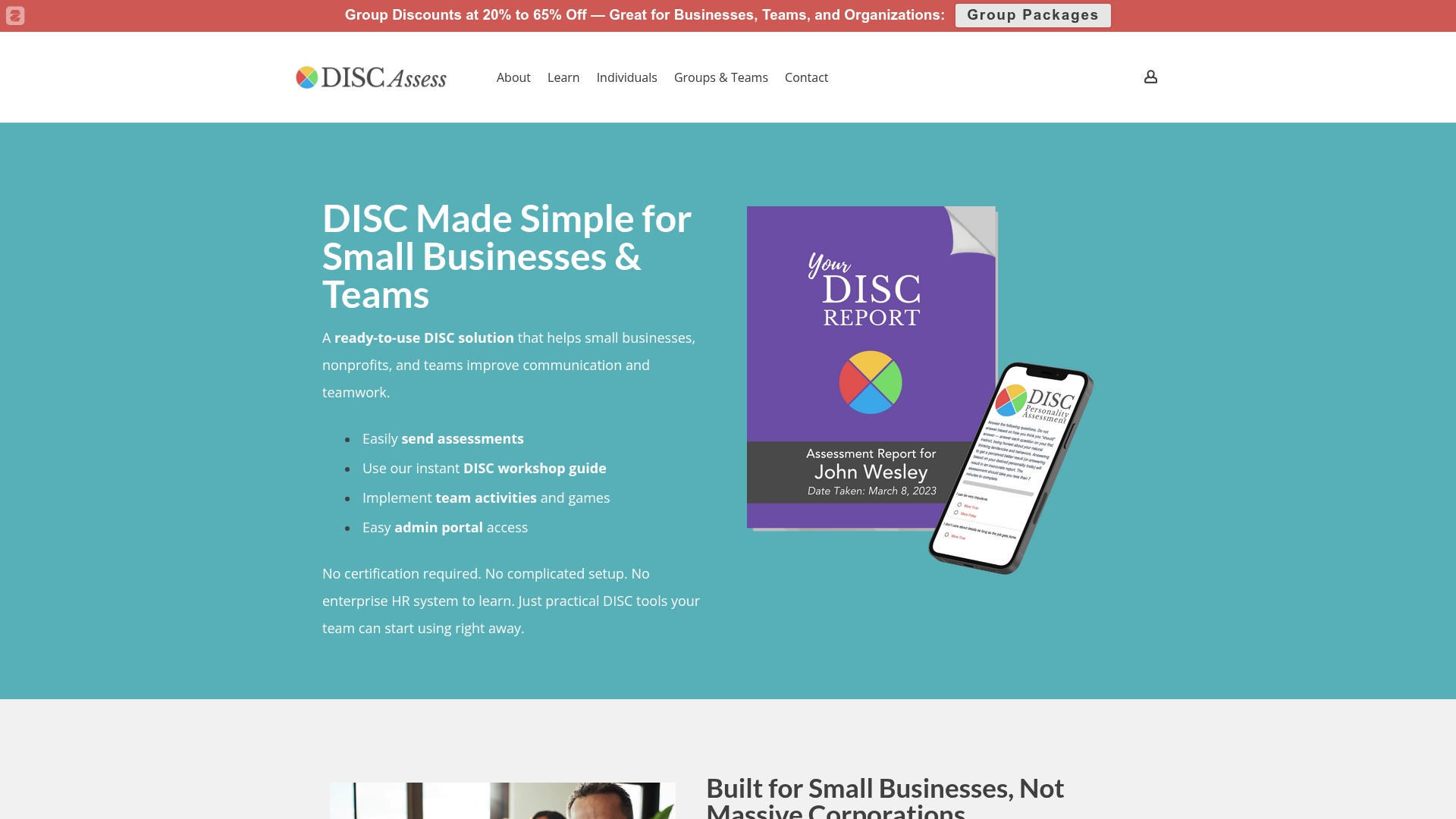
Start with an individual assessment and instant report to establish a baseline, then move to a group package with admin account when you are ready to scale. Organizations that want hands-on support can add live group training for a facilitated debrief. If you want to explore before committing, a free DISC assessment is available to help you experience the tool firsthand. For coaches and consultants who need a branded solution, the White Label DISC System lets you deliver assessments under your own brand. Set up your admin account today and see how straightforward a well-run DISC 360 can be.
Sources
Explore these resources before purchasing or launching a DISC 360 program:
- DISC Group Package (Admin Account + Assessment Credits)
Request a sample report and ask about rater anonymity thresholds before purchasing any 360 package. Those two details tell you more about a vendor's readiness than any marketing page will.