

The single highest-leverage move you can make right now is this: run a DISC group assessment for your team, then hold a 30–45 minute sync to share results and set one concrete adjustment together. That combination addresses the most pressing future workplace challenges, from remote communication gaps to generational friction, faster than any other intervention at this budget level.
Two actions you can take within 48 hours:
- Launch a group DISC assessment through Discassess so every team member receives an instant report.
- Schedule a short team sync (30–45 minutes) to share one key insight per person and agree on one communication adjustment to track over the next two weeks. A simple KPI to start: average response time to async messages, measured before and after.
Key Takeaways
The most effective move against future workplace challenges is a DISC group assessment paired with a structured two-week pilot, giving small teams a clear, affordable path to better communication and measurable retention gains.
| Point | Details |
|---|---|
| Communication gaps are the top challenge | a majority of remote managers cite communication gaps as their primary pain point. |
| Training lifts retention | Teams with trained remote managers report 31% higher retention in surveyed samples. |
| DISC maps style to action | Knowing each person's D, I, S, or C style lets you set the right cadence, feedback tone, and meeting role immediately. |
| Two-week pilot is enough to start | Assess in week one, sync in week two, measure KPIs at week four to six for early signal. |
| Discassess fits small-team budgets | Individual assessments, group packages, and an admin account are all available with no certification required. |
Table of Contents
- What are the real challenges of the future for small teams?
- Why DISC gives you a practical edge against these challenges
- How to manage each DISC type in remote and hybrid settings
- A short, affordable rollout plan your team can start this week
- How to measure impact and avoid common mistakes
- Practical next steps and the right tool for small teams
- What I have seen work in small-team DISC rollouts
- Discassess makes this rollout affordable and immediate
- Sources
What are the real challenges of the future for small teams?
The phrase "challenges of the future" is used broadly, but for small teams and nonprofits, these obstacles are already operational. Small businesses that left temporary remote fixes in place are now experiencing slower projects, longer onboarding, and tool sprawl, meaning the future arrived without a clean solution.
| Challenge | Prevalence / Impact | Why it hurts small teams |
|---|---|---|
| Communication gaps | a majority of remote managers report this as their top pain point | Misaligned async messages waste owner time and slow decisions |
| AI skills gap | Growing across all industries | Small teams lack dedicated trainers; adoption stalls without peer coaching |
| Generational differences | Multiple generations now share most small-team workplaces | Conflicting expectations for feedback frequency and transparency create friction |
| Onboarding at a distance | Longer ramp times without in-person cues | New hires disengage before they contribute, raising replacement costs |
| Burnout and retention risk | Elevated in remote and hybrid settings | Tight teams feel every departure; trained managers see 31% higher retention in surveyed samples |
| Tool sprawl | Common in small orgs that patched remote work quickly | Fragmented platforms create confusion and duplicate effort |
Each of these challenges compounds on a small budget. A single disengaged hire or a miscommunication spiral costs a five-person team proportionally more than it costs a corporation.
Why DISC gives you a practical edge against these challenges
DISC stands for Dominance, Influence, Steadiness, and Conscientiousness. It is a behavioral model that maps how people prefer to communicate, receive feedback, handle conflict, and process change. No clinical diagnosis, no lengthy certification required for basic team use.
Here is how DISC maps directly to the challenges above:
- Communication gaps: Knowing whether a teammate is a high-D (direct, brief) or high-S (patient, relational) tells you exactly how to frame an async message so it lands.
- AI skills gap: High-C team members often adapt to new tools methodically; pairing them as informal coaches for high-I or high-S colleagues accelerates adoption without formal training budgets.
- Onboarding at a distance: A new hire's DISC profile lets their manager set the right check-in cadence from day one, reducing the guesswork that slows remote onboarding.
- Burnout risk: High-S individuals absorb team stress quietly. Knowing this lets leaders check in proactively rather than waiting for a resignation.
AI adoption increases reliance on interpersonal communication skills as a key differentiator, which means the soft-skill clarity DISC provides becomes more valuable, not less, as your team adopts new tools.
Stat to know: Teams with trained remote managers report 31% higher retention rates in surveyed samples, according to Stealth Agents' summary of workforce data.
DISC works for small teams because it is fast (most assessments take under 15 minutes), affordable, and immediately usable without an HR department.
How to manage each DISC type in remote and hybrid settings
The DISC model helps leaders adjust communication and feedback to each style to improve remote team collaboration. Here is what that looks like in practice.
High-D (Dominance): results-focused and direct
- Keep messages short and lead with the outcome, not the backstory.
- Give them ownership of a defined deliverable rather than a committee role.
- Offer feedback as a direct observation tied to a result, not a lengthy review.
- In meetings, assign them a decision-making or closing role to keep them engaged.
High-I (Influence): energized by connection and recognition
- Open video calls with a brief personal check-in before diving into tasks.
- Recognize wins publicly, even in a team Slack channel or brief email.
- Pair them with client-facing or outreach tasks where their enthusiasm adds value.
- Use voice or video for important messages; long text threads drain their engagement.
High-S (Steadiness): values consistency and team harmony
- Communicate changes early and explain the reasoning behind them, as leadership guidance emphasizes communicating the "why" to build trust.
- Keep check-in cadences predictable; surprise pivots create anxiety.
- Invite their input privately before group discussions so they feel heard.
- Watch for quiet withdrawal as a burnout signal and address it early.
High-C (Conscientiousness): detail-oriented and process-driven
- Provide written agendas and follow-up notes for every meeting.
- Give them time to review data before asking for a decision.
- Frame feedback around systems and accuracy, not personal performance.
- Assign them quality-control or documentation roles where precision matters.
Pro Tip: Pair a high-C with a high-I for quality-control and client outreach tasks. The C catches errors and builds the process; the I communicates it warmly. That pairing covers two of the most common remote-team failure points in one move.
A short, affordable rollout plan your team can start this week
| Week | Action | Estimated Cost |
|---|---|---|
| — | Choose your package, set up admin account, brief the team on purpose and privacy | Admin account setup (see Discassess pricing) |
| Week 1 | Send assessments; team completes them independently (under 15 min each) | Individual assessments or group package |
| Week 2 | Hold a 45-minute results sync; share one insight per person; set two-week adjustments | No additional cost |
| Week 4–6 | Measure early outcomes against baseline KPIs; adjust communication norms | Optional: live group training for deeper facilitation |
Buying options at a glance:
- Single assessment: Best for a solo leader or one new hire. Low entry cost, instant report.
- Group package (admin + credits): Best for teams of 4 or more. Centralized results, easier comparison, and lower per-person cost.
- Admin account / unlimited membership: Best for coaches, nonprofits, or organizations running ongoing cohorts or volunteer groups.
Step-by-step checklist:
- Decide which package fits your team size and budget.
- Brief your team: explain the purpose (better communication, not evaluation), confirm participation is voluntary, and clarify how results will be shared.
- Send assessments and set a completion deadline of five business days.
- Review reports as a leader before the sync; note one strength and one growth edge per person.
- Facilitate the 45-minute sync: each person shares one insight; group agrees on one shared adjustment.
- Record your baseline KPIs before the sync so you can measure change at week six.
How to measure impact and avoid common mistakes
KPIs to track before and after your pilot:
- Average async response time (measure in your messaging platform)
- Meeting efficiency score (simple 1–5 self-rating after each meeting)
- Onboarding ramp time for new hires (days to first independent contribution)
- Team engagement score (brief weekly pulse, three questions maximum)
- Voluntary turnover rate (track quarterly)
- Quality metrics relevant to your work (error rate, client satisfaction, deliverable accuracy)
Pitfalls and one-line mitigations:
- Labeling people by type: DISC describes tendencies, not fixed identities. Remind your team of this at every touchpoint.
- Privacy and data handling: Store raw reports securely; share only what each person consents to share.
- Overreliance on assessments: DISC informs conversations; it does not replace them. Use results to open dialogue, not close it.
- Skipping the baseline: Without a before measurement, you cannot demonstrate progress. Record your KPIs in week zero.
- Manager unpreparedness: A brief read-through of each report before the sync prevents misinterpretation. The DISC for workplace teams manager's guide is a useful pre-read.
Practical next steps and the right tool for small teams
Discassess offers three options that fit the rollout plan above without requiring a large budget or an HR department.
The Individual Classic DISC Assessment is the right starting point for a solo leader or a single new hire who needs a fast, clear report. The DISC Group Package gives you an admin account plus assessment credits, making it the practical choice for teams of four or more who want centralized results and easier facilitation. The White Label DISC System is built for coaches and consultants who want to deliver DISC under their own brand to multiple client groups.
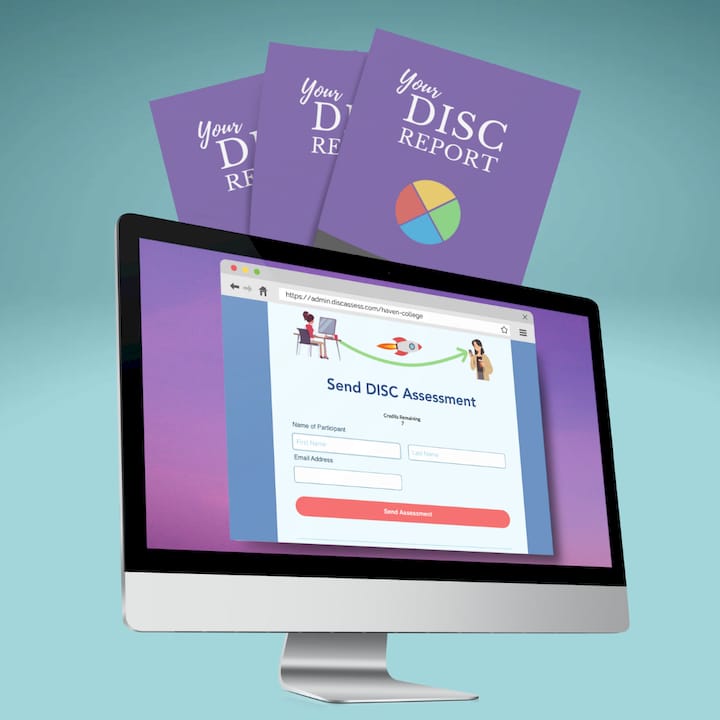
For your two-week quick start: in week one, purchase your package, set up the admin portal, and send assessments with a clear privacy note. In week two, hold the sync, record your baseline KPIs, and assign one communication adjustment per person. By week four, you will have enough signal to know whether the pilot is worth expanding.
Pro Tip: If your team includes volunteers or part-time contributors, the group package admin account lets you add them without purchasing separate assessments each time, which keeps per-person costs low as your organization grows.
What I have seen work in small-team DISC rollouts
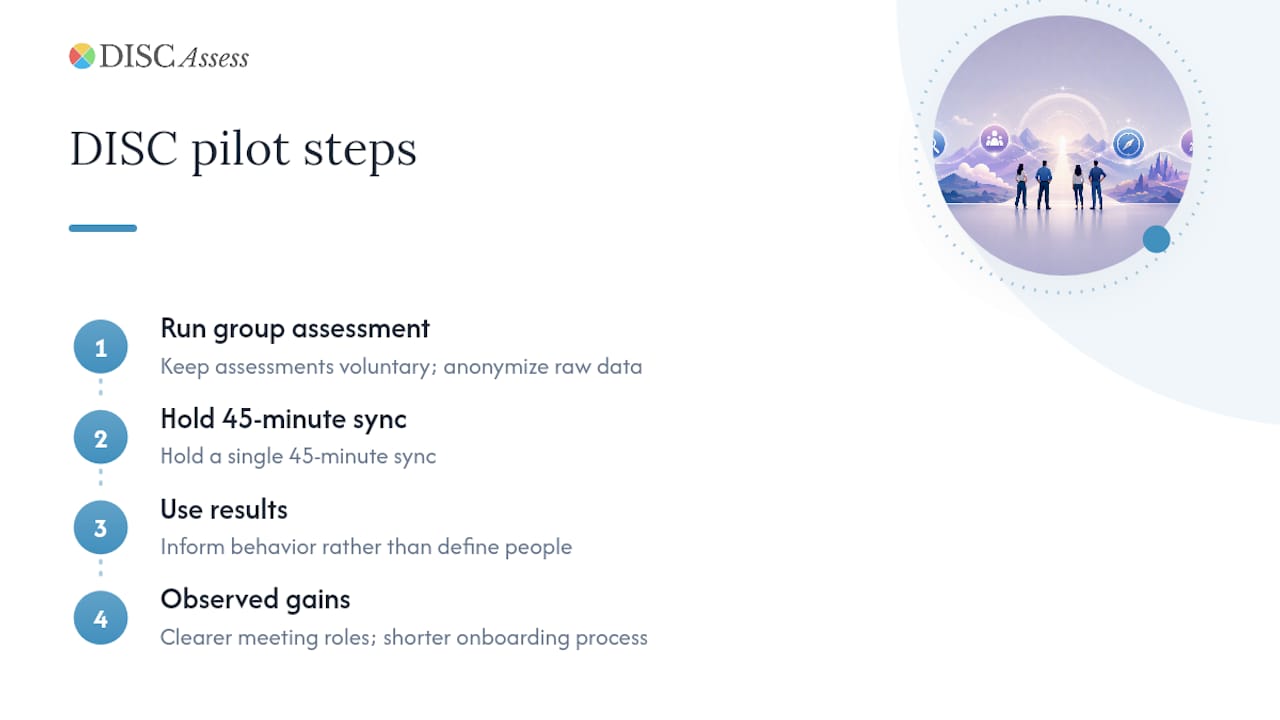
Running DISC pilots with small teams consistently surfaces one pattern: the biggest gains come not from the assessment itself but from the conversation it opens. A five-person nonprofit team that completed a group assessment and held a single 45-minute sync reported clearer meeting roles and a noticeably shorter onboarding process for their next hire, simply because the manager knew which communication style to match from day one.
Keep assessments voluntary, anonymize raw data when sharing across the group, and use results to inform behavior rather than define people. That discipline is what separates a DISC rollout that builds trust from one that creates anxiety.
Discassess makes this rollout affordable and immediate
Discassess, backed by Prism Counseling & Coaching with over a decade of experience, is built specifically for small businesses, nonprofits, and coaching practices that need professional-grade DISC tools without a corporate price tag. No certification required. Instant reports. An admin portal that lets you manage group results in one place.
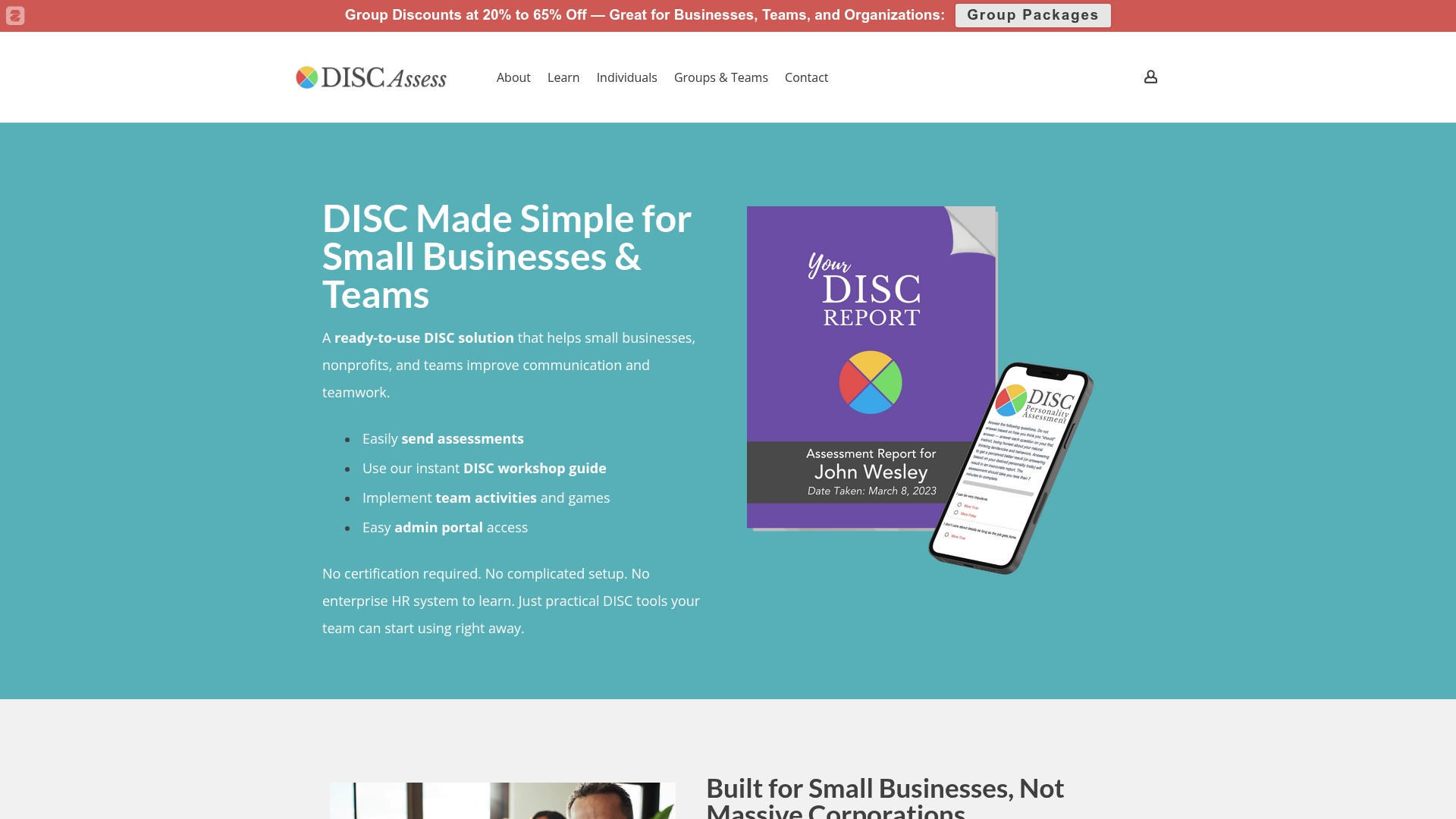
Whether you need a single assessment for a new team member or a group package for your whole organization, Discassess offers tiered pricing that fits a modest budget. A faith-based version is also available for ministry and church teams. Ready to start your two-week pilot? Set up your admin account today and send your first assessments before the week is out.
Sources
- Remote Teams in 2026: What Small Businesses Need to Rethink — Cohensa
- Leadership Challenges in 2026: Key Issues & Solutions