

DISC consulting is the practice of using a DISC assessment to diagnose behavioral tendencies and turn those insights into billable coaching, team workshops, or leadership development programs. Coaches, consultants, and independent facilitators benefit most, since DISC gives you a shared language that speeds up client conversations. The next step is simple: pilot one assessment with a single client or team before you build a full offering around it.
TL;DR:
- Most clients see value when DISC assessments are bundled with debrief sessions, follow-up actions, or ongoing coaching rather than sold as standalone reports.
- A pilot with six to twelve participants allows consultants to evaluate assessment effectiveness and identify common explanation challenges before expanding offerings.
- Using a clear, measurable client outcome such as reducing onboarding time or conflict frequency increases program renewal chances.
- The right platform should facilitate group management, instant report download, and branding options, reducing prep time and data entry.
- Clients with concrete problems like prolonged onboarding or communication friction are more receptive to DISC, while those expecting performance or skills evaluations are less suitable.
Table of Contents
- What DISC Means for Consultants: Model and Reports You'll Use
- Primary Use Cases: Coaching, Teams, Hiring, and Programs
- Best Practices for Packaging, Pricing, and Selling DISC Services
- Choosing and Implementing a DISC Platform: A Quick Checklist
- How DISC Assess Supports Consultants
- How to Assess Client Readiness for Using DISC
- Strategies for Integrating DISC With Other Assessment Tools
- Ethical Considerations and Data Privacy in DISC Work
- Case Studies: DISC in Real Consulting Engagements
- Practitioner Perspective: Strengths, Limits, and When to Use DISC
- Get Started With Discassess's Consultant Packages
- Sources
- FAQ
What DISC Means for Consultants: Model and Reports You'll Use
DISC organizes behavior into four dimensions: Dominance, Influence, Steadiness, and Conscientiousness. Dominance and Influence describe outward, faster-paced tendencies, while Steadiness and Conscientiousness describe more measured, detail oriented ones. Most reports also distinguish natural behavior (how someone acts under normal conditions) from adapted behavior (how they act under stress or workplace pressure), which matters when a client swears their profile "doesn't sound like them" until you separate the two.
For a working consultant, the model matters less than what it produces on paper. A typical DISC report gives you three deliverables you can hand a client directly:
- An individual profile summary describing communication style, motivators, and stress responses
- A team map plotting every member's style so patterns of friction or alignment become visible at a glance
- Behavioral priorities and development recommendations tied to specific workplace situations, not abstract traits
Consultants gravitate toward DISC because it is fast and workshop-ready. You don't need a clinical background to run a session, and the output translates directly into a slide, a handout, or a coaching conversation. DISC assessments are used by a very large number of people annually precisely because the model is simple enough to teach in twenty minutes and useful enough to build a program around.
Primary Use Cases: Coaching, Teams, Hiring, and Programs
DISC earns its place in a consulting practice when it attaches to a billable deliverable, not when it sits alone as a personality quiz. Here's how that plays out in practice:
- One-on-one leadership coaching. Pair the assessment with a structured debrief and a 90-day development plan that ties the client's DISC style to specific leadership behaviors they want to change.
- Team workshops. Build a team map, then run conflict-reduction exercises and role clarity sessions that use the map as the starting reference point for the whole room.
- Hiring and onboarding. Use profiles to frame fit conversations during interviews, then tailor onboarding plans so new hires get communication guidance suited to how they actually process information.
- Program offerings. Package cohort-based development tracks or retainer coaching that includes periodic reassessments, so clients see behavioral change documented over months, not just in a single report.
Coaches and consultants commonly lean on DISC as a coaching and workshop tool precisely because it produces this range of applications from one instrument. You're not selling four different products. You're selling one assessment used four different ways, which is a much easier pitch to a small-business client with a limited training budget.
Best Practices for Packaging, Pricing, and Selling DISC Services
Clients don't buy a personality test. They buy faster onboarding, fewer misfires between employees, and clearer expectations around performance. Lead every pitch with the outcome, then mention the assessment as the mechanism that gets them there.
A few packaging moves consistently perform better than selling a bare report:
- Bundle the report with a 90-minute debrief so the client experiences a guided conversation, not just a PDF
- Combine a team workshop with a follow-up action plan delivered two to four weeks later
- Offer a subscription tier for ongoing coaching paired with periodic reassessments, which keeps the relationship active instead of one-and-done
- Provide branded (white-label) reports, facilitator notes, and client-ready slide decks so the deliverable looks like part of your practice, not a third-party printout
Consultants and coaches sell DISC most effectively when the offer is framed around a bundle, since a bundled price is easier to justify than a per-report fee. Pricing shapes vary: a flat fee per assessment credit, a per-workshop fee that includes materials, or a retainer that includes a set number of monthly credits for ongoing client work.
Pro Tip: Tie every DISC engagement to one measurable client outcome, like onboarding time or meeting length before you ever run the assessment. Clients renew programs they can point to on a spreadsheet, not ones they only remember as "interesting."
Choosing and Implementing a DISC Platform: A Quick Checklist
The right platform saves you hours of manual report assembly. Look for an admin portal that lets you manage groups, group credits you can allocate across clients, instant downloadable reports, and at least basic branding so the output looks like yours.
Before committing to a full offering, run a pilot:
- Recruit 6 to 12 people from one willing client or your own team
- Administer the assessment and schedule a structured debrief session
- Collect informal feedback and track one simple metric, such as meeting length or number of logged conflicts, before and after
- Note what took the longest to explain, since that becomes your next workshop slide
On certification: enterprise and executive-coaching clients sometimes expect a recognized credential before they'll sign a contract, while small-business engagements usually care more about your facilitation skill and the results you can show. Some platforms let consultants generate reports and manage groups without prior external certification, building competence through in-portal training instead. Whichever path you choose, confirm how the platform stores and protects client data before your first paid session.
How DISC Assess Supports Consultants
Discassess builds its platform around the parts of a consulting practice that actually slow people down: setting up groups, chasing down reports, and prepping facilitator materials at midnight before a workshop. The admin portal, group management tools, and instant reports exist specifically so you spend your prep time on the debrief conversation, not the data entry.
A few platform features map directly onto what a working consultant needs:
- An admin portal for managing multiple client groups without juggling spreadsheets
- Instant, downloadable reports so a debrief can happen the same day the assessment closes
- Facilitator resources built for workshop delivery, not just individual self-review
- Packages sized for small teams rather than enterprise licensing minimums
DISC Assess offers consultant-facing features including group admin accounts and membership options built for coaches running multiple client engagements rather than a single HR department.
How to Assess Client Readiness for Using DISC
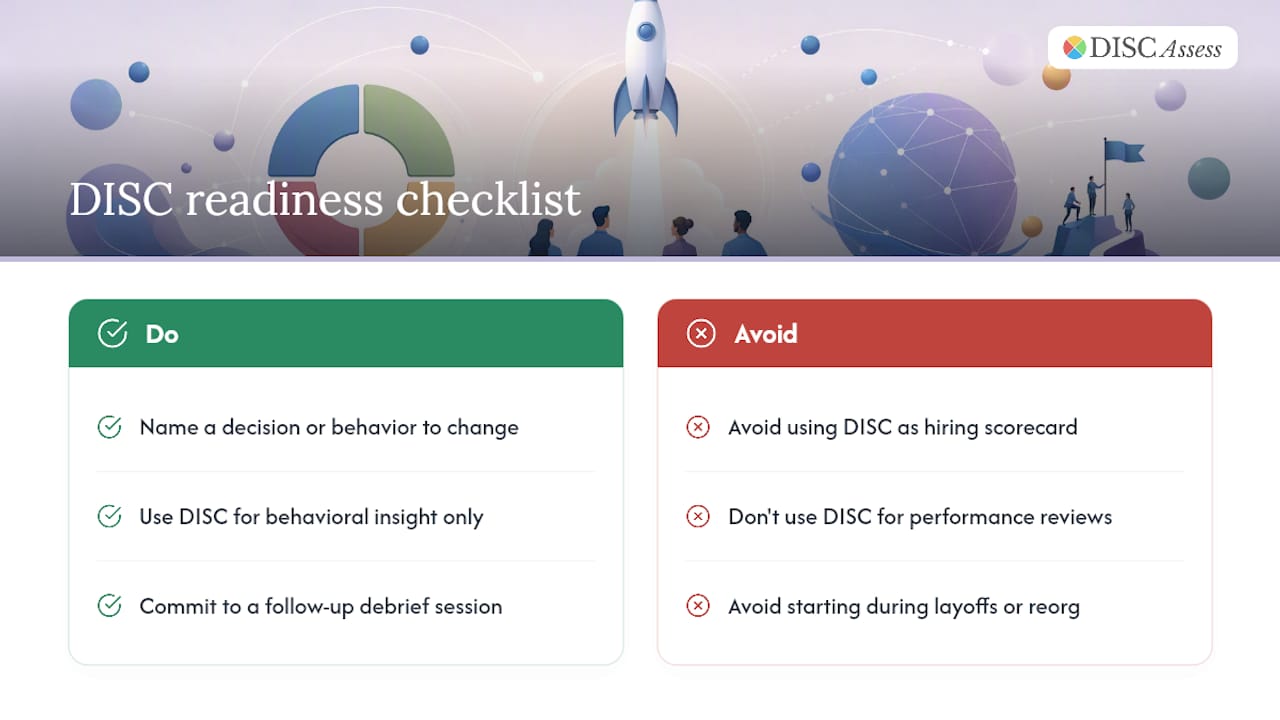
Not every client or team is ready for a DISC engagement the moment you propose one. The clearest readiness signal is a specific, named problem: onboarding takes too long, two managers keep clashing, or a team has grown fast and lost its sense of who does what. Clients who can describe a concrete friction point get more value from DISC than clients who simply want "a fun team activity."
Watch for a few appropriateness markers before you commit to a full program. A leader who treats the assessment as a scorecard for firing decisions is misusing the tool; DISC describes behavioral style, not competence or performance. A team in the middle of layoffs or a contentious reorganization often needs conflict mediation or clearer communication of decisions before a personality framework will land well. And a client expecting DISC to replace a skills assessment or a performance review is asking the tool to do a job it was never built for.
The simplest readiness check is a short intake conversation: ask what decision or behavior the client wants to change, and whether they're willing to commit to a follow-up session, not just a one-time report. If they can't name a decision the assessment will inform, delay the engagement until they can. Clients who buy in during the intake stage almost always get more out of the debrief, because they arrive with a real question instead of vague curiosity about their "color."
Strategies for Integrating DISC With Other Assessment Tools
DISC works best as one instrument in a broader toolkit, not a standalone diagnostic. It measures observable behavioral style, which makes it a strong complement to tools that measure different things entirely, such as values inventories, 360-degree feedback processes, or emotional intelligence assessments.
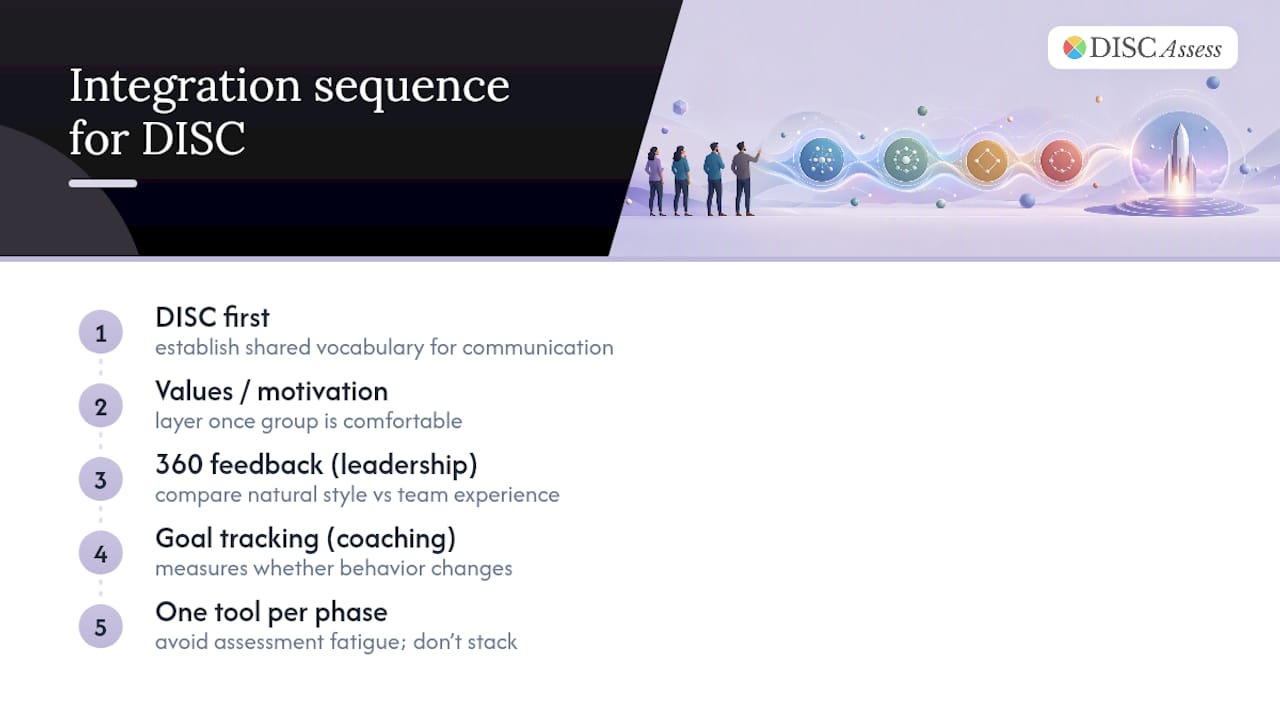
A practical integration sequence looks like this: use DISC early in an engagement to establish a shared vocabulary for how people communicate, then layer in a values or motivation assessment once the group is comfortable talking about style differences. For leadership development specifically, pairing a DISC profile with 360 feedback lets a client see both how they come across naturally and how their team actually experiences them, which are often two different pictures.
Avoid stacking too many instruments into one engagement. Clients lose patience with assessment fatigue quickly, and consultants who pile five tools into a kickoff week often dilute the impact of each one. A cleaner approach ties DISC to a single complementary tool per program phase, so each instrument gets its own moment to land rather than competing for attention in the same debrief. If you're building leadership coaching specifically, DISC combined with structured goal tracking tends to outperform DISC alone, since the profile explains the "why" behind a behavior while the goal tracking measures whether it's actually changing.
Ethical Considerations and Data Privacy in DISC Work
DISC results describe tendencies, not fixed limitations, and treating a profile as a permanent label is the most common ethical misstep in consulting work. A "high D" employee isn't destined to be domineering forever, and framing results that way in front of a team can do real damage to how colleagues perceive each other going forward.
Consent matters more than most consultants initially assume. Every participant should understand, before taking the assessment, how results will be used, who will see them, and whether results affect any employment decision. Using DISC results in a hiring or termination decision without disclosing that intent upfront crosses an ethical line that most clients don't realize they're close to until a consultant flags it.
Data handling deserves the same seriousness as consent. Confirm how your assessment platform stores results, who has access inside a client organization, and how long data persists after an engagement ends. Small-business clients rarely have an HR compliance team reviewing this, which puts more responsibility on the consultant to set the standard. A short checklist before every engagement, covering consent language, access limits, and storage duration, prevents most of the problems that surface later.
Case Studies: DISC in Real Consulting Engagements
A common pattern shows up across small-team engagements: a nonprofit hires a facilitator ahead of a merger of two program teams, runs a group DISC assessment, and uses the resulting team map to structure a half-day workshop around communication friction points the staff had never named out loud, which is why évaluer l'organisation existante de son entreprise can be a critical early step in the consulting process. The debrief becomes less about the four letters and more about giving people permission to say, "I process decisions slower than you, and that's not a flaw."
Leadership coaching engagements follow a different arc. A consultant debriefs an individual profile, builds a 90-day development plan around one specific behavior (say, a high-D leader learning to pause before interrupting), and checks in monthly. The DISC profile provides the vocabulary for the goal, but the coaching relationship and the tracked behavior change are what the client actually pays for over time.
Related resources on leadership coaching walk through how consultants structure these longer engagements around a single assessment touchpoint. Volunteer-heavy organizations offer a third pattern: a short onboarding workflow using one-page cheat sheets gets new volunteers oriented to team communication styles in under fifteen minutes, without requiring a full workshop budget.
Practitioner Perspective: Strengths, Limits, and When to Use DISC
DISC earns its keep because it's fast, workshop-ready, and gives a team shared vocabulary in a single session. Its limit is just as clear: it isn't a clinical or diagnostic tool, and consultants who oversell its predictive power eventually get caught out by a client who expected more than a behavioral snapshot. The strongest engagements pair DISC with a concrete client goal and a simple way to track whether that goal is actually moving.
— Tres
Get Started With Discassess's Consultant Packages
Discassess is built for coaches and small-team consultants who want to run DISC programs without enterprise pricing or long licensing waits. Discassess passes along savings from skipping publisher licensing and gets you running assessments the same day you sign up.
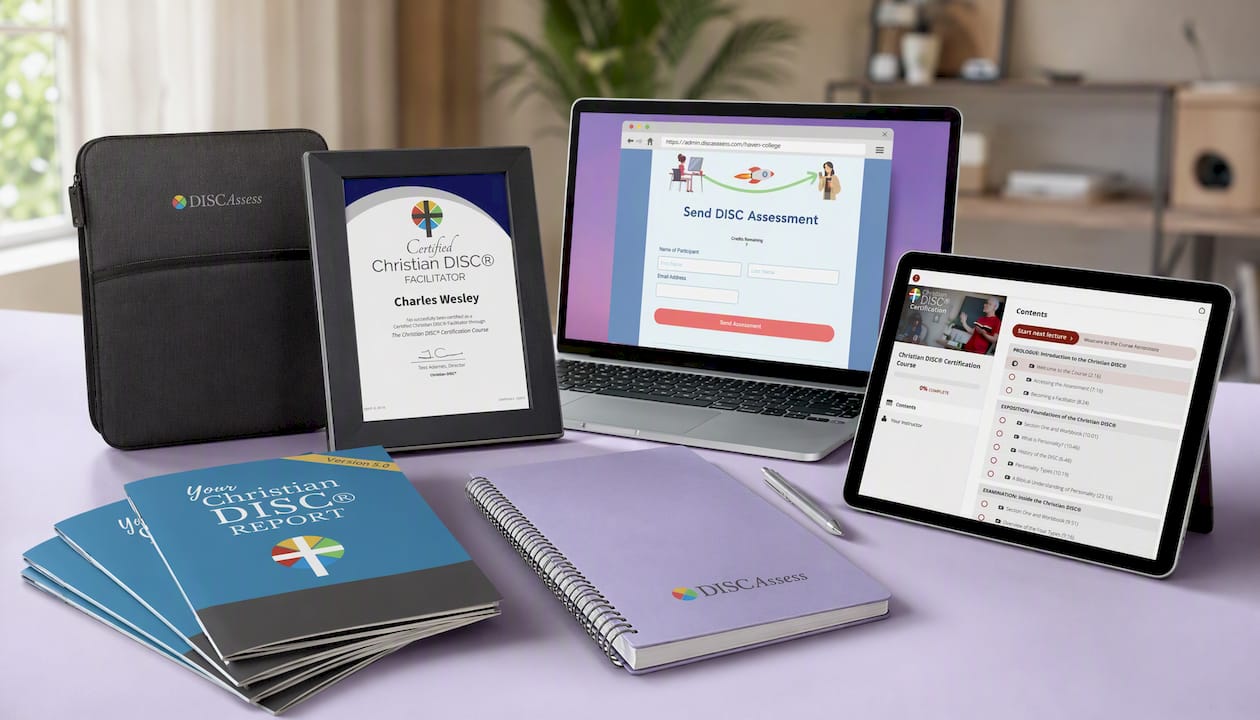
If you're piloting your first team engagement, the Group Admin Account gives you the credits and admin portal to manage everyone in one place. Consultants running larger cohorts or faith-based coaching programs can look at the Pro Group Package or explore the Christian DISC® Certification Course if a client base expects that credential. For ongoing facilitator work across multiple clients, the Extended Pro Membership covers six months of access built specifically for people running assessments professionally.
Start smaller if you're still testing the waters: order a single assessment with report for yourself or one client, run the debrief, and see how it lands before you build a full program around it.
Sources
FAQ
Is DISC Certification Worth It for Consultants?
Certification is worth it mainly for consultants targeting enterprise or executive-coaching contracts, where clients often expect a recognized credential before signing. For small-business engagements, demonstrable facilitation skill and documented results from prior sessions usually carry more weight than the credential itself.
What Is the Rarest DISC Profile?
DISC vendors don't publish a definitive ranking of profile rarity, since population distributions vary by industry, sample, and assessment provider. Rather than chasing a "rarest type" claim, focus on how a client's specific style shows up in their actual work behavior.
What Are the Four DISC Leadership Styles?
The four DISC dimensions, Dominance, Influence, Steadiness, and Conscientiousness, translate into distinct leadership approaches: decisive and results-driven (D), persuasive and relationship-focused (I), steady and collaborative (S), and analytical and detail-oriented (C). Most leaders show a blend of two dimensions rather than a single pure style.
How Do I Start Offering DISC as a Consultant?
Start with a single pilot assessment on one client or your own team rather than building a full program upfront. Platforms like Discassess let you purchase an individual assessment or a small group package to test the debrief process before committing to a larger membership or certification path.