

DISC for churches means a faith-adapted version of the DISC personality assessment, built to help pastors, volunteer coordinators, and ministry teams communicate better, place people well, and grow as disciples. It's meant for anyone leading staff, volunteers, or small groups. If your congregation is ready to try it, start small: order a group package, set up the admin portal, and run your first debrief within a month.
TL;DR:
- Using DISC results for volunteer placement effectively reduces burnout by matching Steady types with consistent roles and Influencing types with energetic, event-based tasks.
- Leaders should focus on applying assessment insights over months, measuring retention, engagement, and team dynamics after initial debriefs to see real results.
- Confidentiality is essential, with reports kept private, stored securely, and participants fully informed that DISC measures behavior, not spiritual maturity or character.
- A simple five-step rollout—deciding scope, purchasing, running a short kickoff, measuring outcomes, and investing in sustainability—can be completed in about a week or two.
- Discassess offers affordable, flexible assessments and resources starting at $49 each, supporting churches in applying DISC for internal growth and volunteer management.
Table of Contents
- What Is a Faith-Based (Christian) DISC Assessment?
- The Four DISC Types in a Church Setting
- How Churches Actually Use DISC Results
- What's Included in a Typical Church DISC Package
- A 5-Step DISC Rollout Checklist for Small and Mid-Sized Churches
- Ethical Considerations and Confidentiality in Church DISC Use
- Using DISC Results in Pastoral Counseling and Spiritual Growth
- Real-World Impact: How DISC Plays Out in Ministry Contexts
- What We've Learned From Church DISC Rollouts
- How Discassess Can Support Your Church's DISC Rollout
- Sources
- FAQ
What Is a Faith-Based (Christian) DISC Assessment?
DISC measures behavior on four dimensions: Dominance, Influence, Steadiness, and Conscientiousness. Originally developed for secular workplaces, the model has become a common tool for improving communication and team functioning in businesses of every size. A faith-based version keeps that same four-factor structure but reframes the language, examples, and applications around discipleship, church leadership, and ministry teams instead of sales quotas and office hierarchies.
A typical church report includes:
- A personality summary written in plain, ministry-friendly language
- Insights tied to spiritual growth and how each type tends to serve, lead, or relate within a congregation
- Suggested ministry roles based on natural behavioral tendencies
- Optional group reports that show how an entire staff or volunteer team fits together
Choose the faith-based version for internal discipleship work, staff development, and volunteer engagement, where biblical framing helps the results land with more meaning. Classic (non-faith) DISC still works well for outreach programs, community partnerships, or contexts where you want a neutral tool that doesn't assume shared belief. Many churches keep both available. Discassess offers Classic DISC Assessment and Christian DISC® Assessment reports side by side, so a single order form can serve both needs.
The Four DISC Types in a Church Setting
Every congregation run on the same four behavioral engines, whether people realize it or not. Recognizing them early saves months of friction on committees and ministry teams.
- Dominant (D): Direct, decisive, and driven to get things done. D-types often thrive as building committee chairs, outreach directors, or anyone leading a building campaign where decisions can't wait.
- Influencing (I): Warm, expressive, and energized by people. I-types tend to excel at greeting teams, worship leadership, and hospitality ministries where enthusiasm is contagious.
- Steady (S): Patient, loyal, and consistent. S-types often make the best small group leaders, prayer chain coordinators, or nursery volunteers, roles that reward long-term faithfulness over flash.
- Conscientious (C): Careful, analytical, and detail-oriented. C-types frequently gravitate toward finance committees, tech and media teams, or record-keeping roles where accuracy matters more than speed.
Pro Tip: When you meet with a Conscientious volunteer, hand them a written summary before the conversation even starts. Practitioners note that C types trust data and detail over verbal recaps, so a one-page printout will earn more buy-in than the best speech you could give.
Lead a D-type with clear goals and room to run. Lead an I-type with genuine relationship and public encouragement. Lead an S-type with stability and advance notice of change. Lead a C-type with facts, time to process, and respect for their questions.
How Churches Actually Use DISC Results
The real value of a disc for church staff and volunteers shows up months after the initial assessment, once leaders start applying the results instead of just filing the report.
- Volunteer placement: Matching a Steady type to children's ministry and a Dominant type to a building project cuts down on burnout and mismatched assignments.
- Leadership development and succession planning: Coaching an Influencing associate pastor to strengthen follow-through, or preparing a Conscientious deacon to eventually chair the elder board, becomes a targeted process rather than guesswork.
- Conflict resolution: A D-type and an S-type clashing over pace of change usually isn't a spiritual maturity problem. It's a communication style mismatch that DISC makes visible fast.
- Team-building: Staff meetings run smoother once everyone understands why the worship director talks fast and the treasurer wants everything in writing.
Ministry-focused guides recommend tracking a few simple measures after rollout: volunteer retention over the next two or three ministry cycles, attendance at team meetings, and general engagement scores from staff surveys. Practical church DISC guides suggest pairing DISC with a spiritual gifts inventory for the fullest picture, since DISC explains how someone behaves while a gifts assessment explains what they're equipped to do. One tool alone tells half the story.
What's Included in a Typical Church DISC Package
Before you budget for a rollout, it helps to know what a standard church package actually includes. Vendors vary, but most bundles share a similar shape.
- Individual reports, ranging from a concise one-page summary to a fuller multi-page breakdown of tendencies and ministry suggestions
- Group reports that visualize how an entire team or staff distributes across the four types
- An admin portal for sending assessment invitations, tracking completion, and storing results in one place
- Workshop materials, including slide decks, leader worksheets, and interactive debrief activities that ministry-focused suppliers commonly bundle in as standard inclusions
- One-page cheat sheets volunteers can keep for quick reference on communication styles
- Purchase models ranging from single assessments to bulk credits, unlimited membership plans, and optional facilitator certification for churches that want to run their own workshops long term
Setup timelines are usually short. Most churches can purchase a package, load names into the admin portal, and have a full staff or volunteer team assessed within a week or two, assuming leadership has already decided on scope.
A 5-Step DISC Rollout Checklist for Small and Mid-Sized Churches
Rolling out DISC doesn't require a committee, a budget meeting, and three months of planning. It requires a decision and an afternoon.
- Pick your scope. Decide whether this launches with paid staff only, volunteer leaders, or the whole congregation. Starting narrow, then expanding, beats trying to assess everyone in week one.
- Purchase and configure. Buy credits or a membership tier and load your team into the admin portal so invitations go out in one batch instead of one-by-one emails.
- Run a short kickoff. Ministry guides recommend individual assessments that take 10 to 15 minutes, followed by a 45 to 60 minute group debrief where you hand out cheat sheets and walk through what each type means for your team specifically.
- Document and measure. Record role matches on paper, not just in memory, and check back on retention and engagement after one ministry cycle, typically around three months.
- Invest in sustainability. A facilitator seat or a short coaching session helps DISC stick as a living tool instead of a one-time novelty everyone forgets by Easter.
Pro Tip: Don't skip the written cheat sheets, even for a small staff of five. A brief printed summary alongside the verbal debrief helps every type retain the material, not just your Conscientious volunteers.
For a more detailed walk-through built specifically for pastoral staff, see this 5-step DISC rollout for pastors.
Ethical Considerations and Confidentiality in Church DISC Use
Handing a personality report to a staff member or volunteer carries real weight, especially inside a church community where relationships run deep and roles often overlap with friendships. Confidentiality has to be treated as a first principle, not an afterthought.
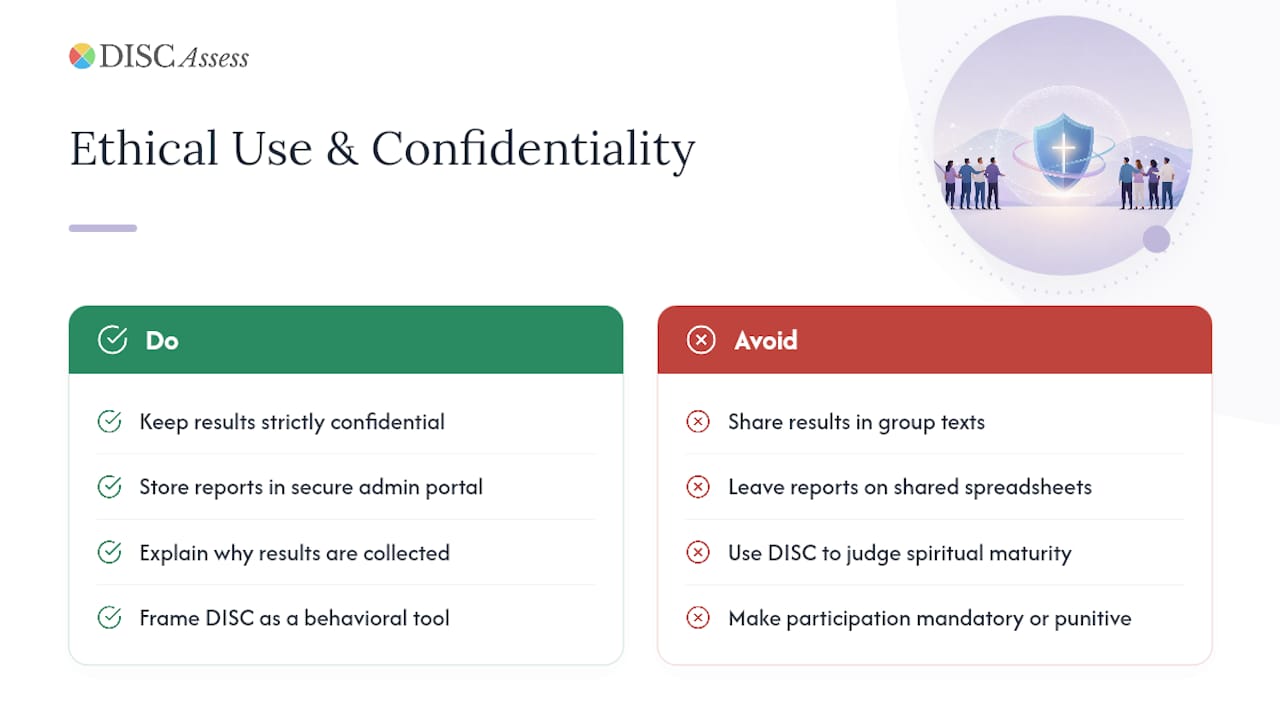
Results should stay between the individual, the person administering the assessment, and whoever directly needs the information to make a placement decision. A youth pastor's DISC results shouldn't circulate through a deacon board group text. Store reports in a secure admin portal rather than shared spreadsheets or printed stacks left in a church office.
DISC also has real limits worth naming out loud. It measures behavioral tendencies, not spiritual maturity, character, or calling. A Dominant type isn't more spiritually gifted for leadership than a Steady type, and a low score on any dimension isn't a character flaw. Presenting results with that framing, clearly and consistently, protects volunteers from feeling reduced to a four-letter label.
Consent matters too. Volunteers and staff should understand why they're being asked to take an assessment, how the results will be used, and that participation isn't a referendum on their standing in the church. Framing the assessment as a tool for mutual understanding, rather than a gatekeeping mechanism for ministry access, keeps the process pastoral rather than clinical.
Using DISC Results in Pastoral Counseling and Spiritual Growth
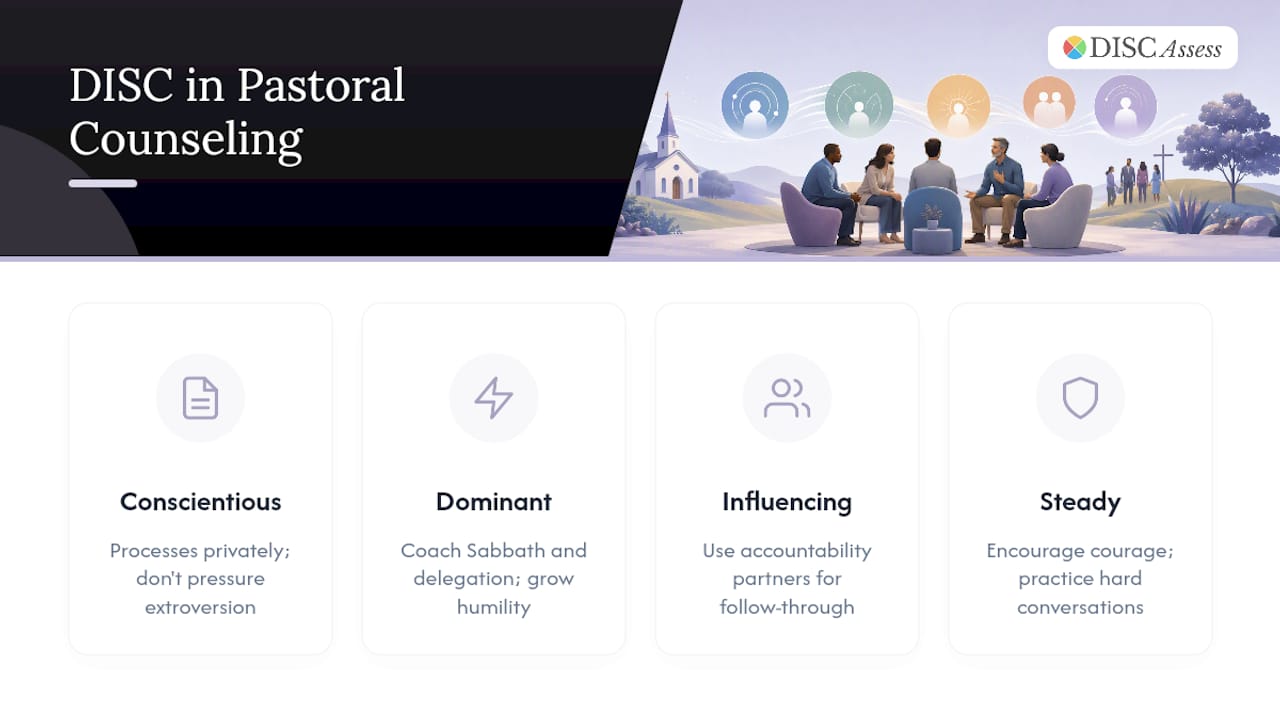
DISC results can genuinely deepen pastoral conversations, but only when a leader reads them as one input among several rather than a verdict. A Conscientious member who seems distant in small group might simply process faith privately before speaking; that's a behavioral pattern, not a spiritual deficiency. Naming it accurately can relieve a member from feeling pressured to perform extroverted faith they don't have.
In one-on-one discipleship, DISC gives pastors a shared vocabulary for growth conversations. A Dominant leader burning out from overcommitment might need coaching toward Sabbath and delegation, framed around biblical rest rather than corporate burnout language. An Influencing member struggling with follow-through on personal disciplines might benefit from accountability partnerships that lean into their relational strength rather than fighting it.
The goal isn't to explain away sin or spiritual struggle as "just a personality type." DISC describes natural tendencies; sanctification still calls every type toward Christlikeness, sometimes by leaning into strengths and sometimes by working against natural grain. A Steady type avoiding hard conversations out of comfort still needs to grow in courage. A Dominant type steamrolling others in decision making still needs to grow in humility. DISC simply gives the counseling conversation more precision about where growth work should start.
Real-World Impact: How DISC Plays Out in Ministry Contexts
A midsize church staff struggling with tension between its worship director and administrative pastor found the root cause almost immediately once both took DISC: an Influencing leader who wanted spontaneity clashing with a Conscientious leader who needed a locked-in plan two weeks out. Neither was wrong. Once staff meetings built in a standing planning window that satisfied the C-type's need for structure and left room for the I-type's creative input, friction dropped noticeably.
A children's ministry team facing high volunteer turnover restructured its onboarding around behavioral fit rather than simple availability. Steady types went to consistent weekly classroom roles; Influencing types moved toward greeting and event-based serving where energy mattered more than routine. Retention conversations shifted from "we need more volunteers" to "we need the right volunteers in the right seats."
A small church plant used DISC during a leadership transition, mapping out which elder candidates carried natural Dominant decisiveness versus Steady relational trust, then intentionally paired both temperaments on the new leadership team instead of selecting for one style. The result was a board that moved fast enough to act but slow enough to bring the congregation along.
What We've Learned From Church DISC Rollouts
Across the ministry teams that have adopted DISC well, one pattern shows up again and again: the churches that see the biggest shift in volunteer fit and meeting tone are the ones that treat the debrief, not the assessment itself, as the real work. A report sitting in an inbox changes nothing. A 45-minute conversation where a team actually names its D's, I's, S's, and C's out loud changes how people talk to each other by the following Sunday.
For deeper reading on applying this to your own volunteer base, this guide on reducing volunteer turnover with faith-sensitive DISC walks through the placement side in more detail.
— Tres
How Discassess Can Support Your Church's DISC Rollout
Discassess gives churches a faster, more affordable path into DISC than traditional enterprise providers built for corporate HR departments, without requiring certification just to get started. Because it skips the licensing overhead of legacy publishers, the savings pass straight to your church's budget.
For staff and volunteer teams, Discassess offers the Individual Assessment, Group Admin Account, Unlimited Membership, and more through one simple storefront. Both the Classic DISC Assessment and Christian DISC® Assessment with reports are available at $49 each, so your church can run faith-aware assessments for internal discipleship and neutral ones for community outreach without switching providers. Churches planning ongoing training can add the Extended Pro Membership for facilitators, priced at $894 for six months, to build in-house coaching capacity over time.
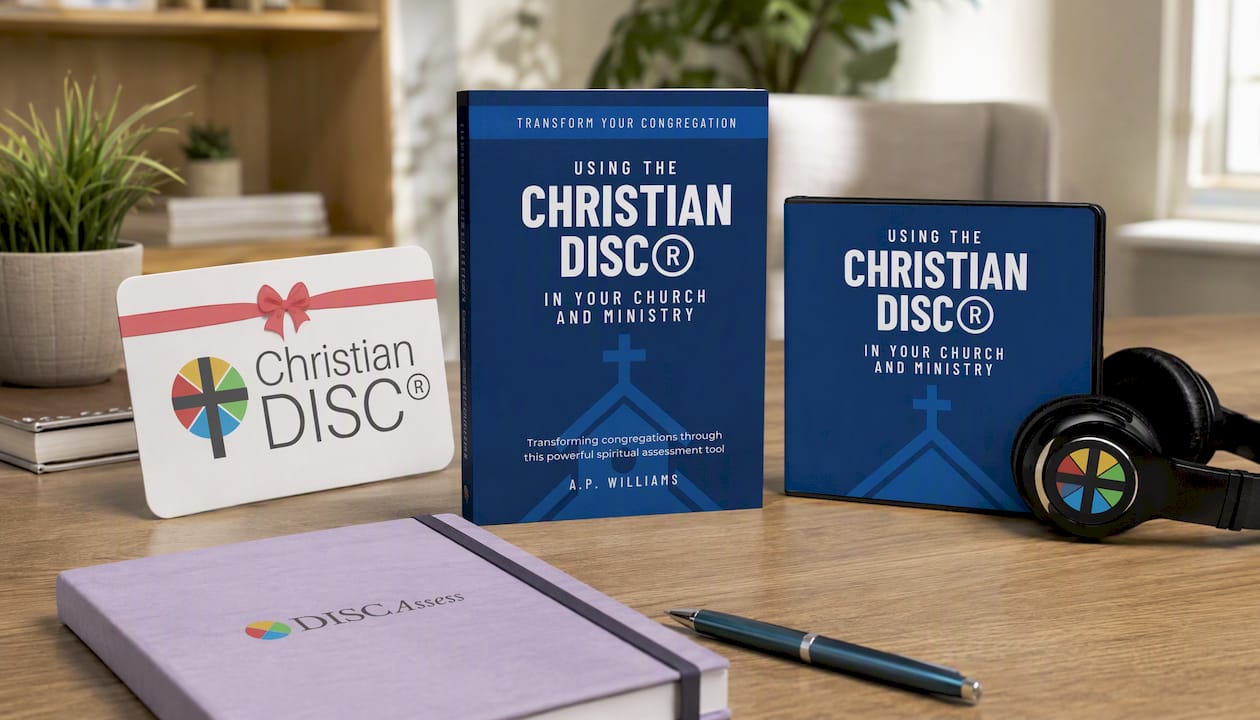
If your congregation wants deeper study resources alongside the assessments, Using the Christian DISC® in Your Church and Ministry is available in both paperback and audiobook formats, and gift cards make it simple to extend an assessment to a staff member or ministry partner. Start by heading to the assessments store and ordering a small group package for your leadership team this week.
Sources
- DISC assessment — Wikipedia
- Using a DISC Assessment To Build Healthy Church Teams — Ministry Vitals
- DISC model — Oxford Leadership
Vendor product pages helped confirm typical deliverables for church DISC packages but aren't cited directly given this article's publisher context.
FAQ
What Are the 12 DISC Personality Types?
The core DISC model has four primary types (Dominant, Influencing, Steady, Conscientious), but many providers break these into secondary blends, sometimes described as numerous subtypes, to capture people who show strong traits in two dimensions at once. Discassess reports focus on clear primary and secondary type combinations rather than a fixed list of twelve labels.
What Is the Rarest DISC Personality Type?
Rarity varies by population and study, and no single DISC type is universally documented as rarest across all settings. What matters more for churches is fit: a "rare" type in your congregation might be exactly the person your leadership team is missing.
What Is the Donation Thing Called in Church?
The traditional donation practice during a worship service is usually called the offering or tithe collection, distinct from "discs" used in DISC personality assessments. Some churches also use NFC "tap to give" plates for contactless giving, which is an unrelated meaning of the word "disc" from the personality tool discussed here.
What Are Some Good Discipleship Programs for Churches?
Strong discipleship programs typically combine small group curricula, mentorship pairings, and self-assessment tools like DISC or spiritual gifts inventories to help members understand both their behavioral tendencies and their calling. Pairing a behavioral tool like DISC with a spiritual gifts assessment gives discipleship leaders a fuller picture than either tool alone.
How Much Does a Church DISC Assessment Cost?
Individual DISC reports through Discassess start at $49 for either the Classic or Christian DISC® version, while churches building a broader program can explore group admin accounts and membership options directly on the Discassess site.