

DISC data privacy means protecting the responses, reports, and metadata generated whenever someone completes a DISC assessment, from the raw answers to the group summaries built from them. The first and most important action for any organization or individual is simple: take stock of exactly what DISC data exists, where it lives, and why it was collected in the first place.
TL;DR:
- DISC data includes sensitive responses, trait scores, timestamps, and metadata that require careful inventory, purpose limitation, and secure disposal policies.
- Cross-referencing group data with other records can re-identify individuals, increasing reputational risks if leaks occur.
- Organizations should restrict access with role-based controls, encrypt data in transit and at rest, and conduct periodic risk assessments before program launches.
- Data retention should be purpose-driven with clear schedules, and deletion must be secure to prevent indefinite accumulation of outdated reports.
- Individuals can safeguard their data by asking about storage policies, requesting deletion, and limiting sharing of results outside authorized contexts.
Table of Contents
- What DISC Data Is and Why It Needs Special Care
- Legal and Regulatory Touchpoints That Affect DISC Data
- Building Privacy-by-Design Controls Into a DISC Program
- What You Can Do to Protect Your Own DISC Data
- Applying NIST and FTC Frameworks to DISC Programs
- How DISC Assess Supports Privacy-Conscious Programs
- Data Protection Versus Data Privacy: Why the Distinction Matters
- Where Conventional DISC Privacy Advice Falls Short
- Start Your Team's DISC Journey With Built-In Privacy Awareness
- FAQ
- Sources
What DISC Data Is and Why It Needs Special Care
DISC assessments generate more than a four-letter result. A typical program produces raw survey responses, derived trait scores, narrative reports, group comparison charts, timestamps, and often IP addresses or device metadata captured by the hosting platform. When a team completes assessments together, that data gets layered into group reports that map relationships between coworkers, which multiplies the sensitivity of what is stored.
Collection usually happens through a handful of familiar paths: HR onboarding sequences, in-person team workshops, coaching engagements, or vendor-hosted online platforms that issue instant reports. Each path moves data through different hands, from the employee taking the assessment to the manager reviewing results to the vendor's servers holding everything in between.
Behavioral data like this carries risks that differ from ordinary contact information:
- Profiling: Patterns in DISC results can be used to make assumptions about an employee's fitness for promotion or conflict potential, often without the person's knowledge.
- Inference: Combined with performance reviews or attendance records, behavioral scores can reveal more than the assessment alone was ever meant to disclose.
- Re-identification: Supposedly anonymized group data can often be traced back to individuals when cross-referenced with team size, role, or department.
- Reputational exposure: A leaked or misused report can follow someone into future job searches or internal politics long after the original workshop ends.
Legal and Regulatory Touchpoints That Affect DISC Data
Most small organizations running DISC programs are not holding financial or medical records, but that does not mean regulation is irrelevant. The Federal Trade Commission's guidance for businesses applies broadly to any entity that collects personal information, and DISC responses tied to a name or employee ID qualify.
A few practical touchpoints worth knowing:
- The FTC's guidance centers on a five-step plan: take stock, scale down, lock it, pitch it, and plan ahead, which doubles as a readiness checklist for any DISC data holder.
- HIPAA can enter the picture only when DISC data intersects with health information, such as when a coaching engagement also touches mental health notes or when a covered entity (a clinic or healthcare employer) administers the assessment.
- State data breach notification laws may apply once DISC records include enough personal detail to count as a reportable incident, so retention and disposal schedules matter as much as collection limits.
A sourced takeaway: the FTC recommends limiting collection and retention of sensitive identifiers and disposing of unneeded data through secure methods like shredding or wiping rather than simply deleting files. For organizations without in-house legal counsel, a DISC program that stores results longer than a stated business purpose requires is a reasonable trigger to ask a lawyer whether retention policy needs tightening.
Building Privacy-by-Design Controls Into a DISC Program
Protecting DISC data does not require an enterprise security budget. It requires sequencing the right actions in the right order, starting with governance before moving to technical and operational layers.
- Inventory what you hold. List every place DISC data lives, who can access it, and why it was collected, mirroring the FTC's "take stock" step.
- Limit purpose and retention. Define how long reports are kept and delete them once that purpose, such as a single workshop or coaching cycle, has passed.
- Restrict access by role. Give managers and facilitators access only to the reports relevant to their teams rather than company-wide visibility.
- Put vendor terms in writing. Confirm in contracts how any hosting provider stores, shares, and disposes of assessment data on your behalf.
- Encrypt data in transit and at rest. Use providers that apply encryption by default rather than leaving reports as unprotected downloads.
- Require multi-factor authentication for any admin account that can view or export group results.
- Log and audit access. Keep records of who viewed or downloaded reports so unusual activity is traceable.
- Dispose of data securely. Permanently delete files and purge backups once a retention period ends, rather than letting old reports accumulate indefinitely.
- Train staff who administer or interpret assessments on what they can and cannot share with others on the team.
- Run a lightweight privacy risk assessment before launching a new DISC initiative, especially one that links results to other HR data.
- Prepare an incident response step, even a simple one, so a lost laptop or misdirected email has a clear next move.
- Revisit the whole process periodically rather than treating privacy controls as a one-time setup.
When DISC data gets linked with other datasets, such as performance records or attendance systems, disclosure-avoidance methods become relevant. Whitepapers on integrated data systems describe techniques for reducing identity, attribute, and inferential disclosure risk when records from separate systems are combined, a concern that applies just as much to a small nonprofit merging volunteer files as it does to large institutions.
Pro Tip: Map "who has a need to know" across your HR and IT systems first. Most DISC data exposures come from access that is simply broader than it needs to be, not from sophisticated attacks.
What You Can Do to Protect Your Own DISC Data
If you are the one taking the assessment, you have more influence over your data than most people realize. A few direct questions and habits go a long way toward keeping your results where they belong.
- Ask before you answer. Find out why the assessment is being administered, how long results will be kept, and who will see them.
- Request access or deletion. Many providers will honor a request to view, correct, or delete your stored results, so check the provider's privacy policy before assuming you have no recourse.
- Practice basic account hygiene. Use a unique password for any assessment platform login, and avoid screenshotting or forwarding personal reports casually.
- Check your employer's policy before sharing results outside the original workshop or coaching context.
- Ask for aggregated output. If you only need to understand team dynamics rather than individual placement, request a group or anonymized summary instead of a personalized report.
Pro Tip: A quick question to a facilitator, "Will this report be stored after today's workshop, and can I see it later?", often reveals more about an organization's privacy practices than any policy document.
Applying NIST and FTC Frameworks to DISC Programs
Two federal resources translate well into a working DISC privacy checklist, even for organizations with no dedicated privacy staff.
The NIST Privacy Framework organizes privacy risk management into five functions. Identify-P means knowing what DISC data you collect and why. Govern-P means assigning someone responsibility for that data, even if it is a single HR lead. Control-P means giving people the ability to access, correct, or delete their results. Communicate-P means telling participants plainly how their data will be used before they take the assessment. Protect-P means applying the technical safeguards, like encryption and access controls, that keep the data secure day to day.
The FTC's five-step plan pairs naturally with this:
- Take stock: inventory every DISC report and data point your organization holds.
- Scale down: stop collecting fields you do not actually use in coaching or team-building.
- Lock it: restrict access and secure storage with encryption and strong authentication.
- Pitch it: dispose of outdated reports on a defined schedule.
- Plan ahead: prepare a simple response plan before, not after, something goes wrong.
Running a privacy risk assessment before a new DISC rollout typically produces three outputs worth keeping on file: a written retention schedule, a short access policy, and a list of mitigations for the specific risks your program raises.
How DISC Assess Supports Privacy-Conscious Programs
We built DISC Assess as a DISC provider for small businesses, nonprofits, teams, and individual users who need a straightforward assessment experience without an enterprise procurement process. Our platform includes assessment tools, group management features, detailed reports, and practical resources for improving communication and team dynamics, all designed for people running the process themselves rather than relying on outside consultants.
We keep the experience simple on purpose, so leadership teams, coaches, and small office staff without deep technical or HR backgrounds can administer assessments confidently. Our organization is backed by Prism Counseling & Coaching, which informs how we structure reports and group tools. We offer several purchasing paths, so buyers evaluating privacy and access controls can review our privacy policy and assessment options before committing to a plan that fits their team's size and data handling needs.
Data Protection Versus Data Privacy: Why the Distinction Matters
These two terms get used interchangeably, but they describe different responsibilities. Data protection refers to the technical and procedural safeguards that keep information secure, encryption, access controls, backups, and secure disposal among them. Data privacy refers to the broader question of what data should be collected at all, who has a right to see it, and what control the individual retains over it.

For a DISC program, data protection is the lock on the door: encrypted storage, role-based access, secure vendor hosting. Data privacy is the decision about whether the door should exist in the first place, how long the room stays open, and whether the person whose results are inside gets a say in who walks through.
An organization can have excellent data protection, strong encryption, careful backups, and still fail at data privacy if it collects more behavioral detail than it needs or keeps reports indefinitely without telling participants. Conversely, a privacy-first program that limits what it collects still needs protection measures to keep that smaller dataset secure. Treating the two as synonyms leads organizations to invest in firewalls while ignoring the more basic question of whether a given report should have been generated, shared, or retained at all. Both deserve a place in any DISC program's written policy, addressed separately rather than folded into one vague statement about "keeping data safe."
Where Conventional DISC Privacy Advice Falls Short
Most guidance on protecting assessment data defaults to generic cybersecurity checklists: use strong passwords, enable two-factor authentication, encrypt your files. None of that is wrong, but it treats DISC data like any other spreadsheet, missing the fact that behavioral profiles carry a particular kind of reputational risk that a stolen credit card number does not.

The gap we see most often is in purpose limitation, not technical security. Organizations collect DISC data for a workshop, then let the reports sit in a shared drive for years because nobody assigned an owner or an expiration date. That is a governance failure, not a technology failure, and no amount of encryption fixes it.
If we could change one habit in how teams handle DISC data, it would be this: treat every assessment as temporary by default. Decide before the workshop how long the results will live and who truly needs to see them, the way good stewardship asks us to consider not just what we gather but what we are called to do with it. Prioritize that conversation over shopping for another security tool, because the tool only protects what governance already decided to keep.
— Tres
Start Your Team's DISC Journey With Built-In Privacy Awareness
If you are ready to bring DISC assessments to your team, nonprofit, or coaching practice, we designed our platform to make that process simple without sacrificing the privacy habits this article has walked through. Our Individual Assessment, Group Admin Account, and Unlimited Membership options let you choose a scale that matches your team, whether that is a single coaching client or an organization-wide rollout.
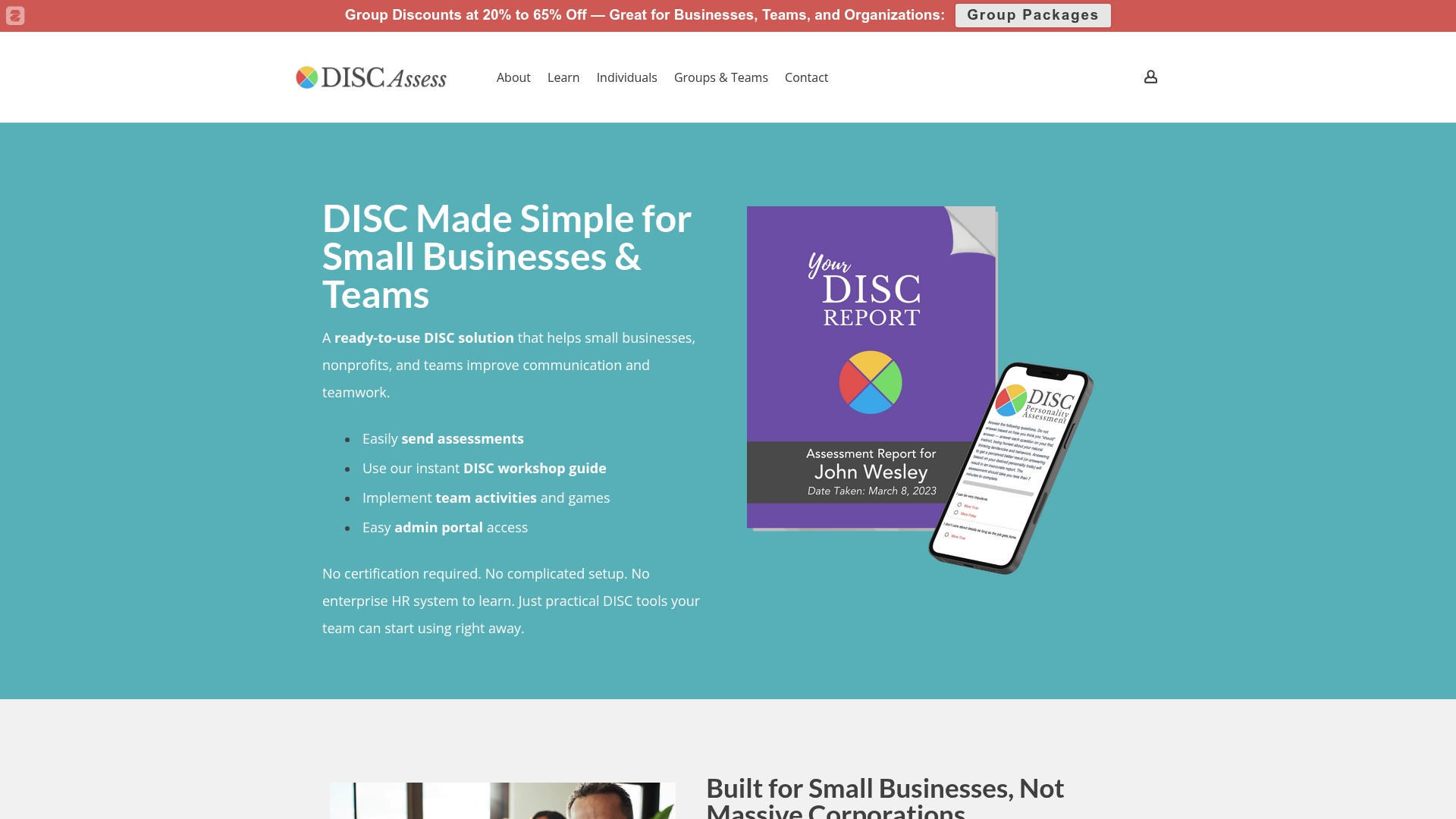
Our assessments come with instant reports, and our admin tools give you role-based access controls, so you decide who sees what inside your organization. If you lead volunteers or a small nonprofit team, our article on using DISC with volunteers offers additional guidance on keeping data collection proportionate to your program's size. Visit our assessment store to find the option that fits your team and get started today.
FAQ
What is data privacy?
Data privacy refers to an individual's or organization's ability to control what personal information is collected, how it is used, and who has access to it. For DISC data specifically, this means knowing why a report was generated and having some say in how long it is kept.
Does Google keep your data private?
This article focuses on DISC assessment data rather than any specific search or technology provider, so we cannot speak to another company's data practices here. For your own DISC results, the better question to ask your assessment provider is what their privacy policy states about storage, sharing, and deletion.
What are 10 ways to protect my personal data?
Strong, unique passwords, multi-factor authentication, limiting what you share, asking providers about retention policies, and requesting deletion when you no longer need a record are among the most practical steps for protecting DISC and other personal data. Reviewing a provider's privacy policy before completing an assessment is one of the simplest and most overlooked habits.
What is the definition of privacy?
Privacy is the state of being free from unwanted observation or intrusion, along with the ability to control access to your personal information. In a DISC context, that means deciding who can view your behavioral results and for how long those results remain on file.
How is DISC data different from other personal data?
DISC data captures behavioral tendencies rather than static facts like an address or birthdate, which makes it more prone to being used for profiling or inference when combined with other records. That distinction is why purpose limitation and retention limits matter as much as basic security controls.
Sources
- Protecting Personal Information: A Guide for Business | Federal Trade Commission
- The NIST Privacy Framework
- Protecting the Privacy of Personal Information in Integrated Data Systems: Disclosure Avoidance Methods