

You can identify your dominant communication style in about five minutes with a free online communication style assessment. Take a quick quiz right now, answer honestly about how you actually behave (not how you wish you behaved), and you'll walk away with a style label, a short list of strengths, and one thing to try in your next conversation.
Quick Stat: Most free communication style quizzes run 3 to 5 minutes and deliver instant results, no waiting, no report to download later.
That's the whole promise. A style label. A few honest strengths and blind spots. One next step you can actually use today.
Key Takeaways
A free communication style quiz gives you an instant style snapshot in minutes, but lasting change comes from practicing one micro-behavior shift and, when you want depth, upgrading to a full DISC report.
| Point | Details |
|---|---|
| Free quizzes are fast | Most take 3 to 5 minutes and deliver results instantly with no signup required. |
| Know your framework | DISC and four-style models (assertive, passive, aggressive, passive-aggressive) measure different things. |
| Results are a snapshot | Self-report scores vary by context and relationship, so treat them as a starting point. |
| Practice one shift | Pick a single scripted phrase from your style's tips and test it in a low-stakes conversation first. |
| Upgrade for depth | Discassess offers a full instant DISC report, team dashboards, and a faith-based option for readers who want more than a label. |
Table of Contents
- What to Expect From a Free Communication Style Assessment Online
- Which Models Do These Quizzes Actually Measure?
- How to Read Your Communication Style Results
- Practical Communication Tips by Style
- Are Free Communication Assessments Accurate?
- Why a Full DISC Report Beats a Free Snapshot
- Frequently Asked Questions
- Sources
What to Expect From a Free Communication Style Assessment Online
A free assessment usually takes a few minutes and gives you results the moment you finish, no waiting on an email, no follow-up call. Most fall into one of three formats: forced-choice questions where you pick between two statements, Likert scales where you rate how much you agree, or short scenario prompts that ask how you'd respond to a specific situation, like a coworker missing a deadline.
Signup requirements vary. Some tools let you see your result instantly with no account at all. Others ask for an email before releasing your full report. That's a fair trade if you want the results saved, but read the fine print on data retention before you hand over your inbox.
Before you start, have a few things ready:
- Think of one recent conversation that felt tense or unclear.
- Pick a single context, work or home, and stick with it for the whole quiz.
- Answer based on your actual behavior, not your ideal self.
Pro Tip: Take the quiz while picturing one specific relationship, like your manager or your spouse, instead of averaging across your whole life. You'll get a sharper, more useful snapshot.
Which Models Do These Quizzes Actually Measure?
Most free tools lean on one of two frameworks. DISC breaks communication into four tendencies: Dominance (direct, results-focused), Influence (outgoing, persuasive), Steadiness (patient, cooperative), and Conscientiousness (analytical, precise). Others use a simpler four-style model built around assertive, passive, aggressive, and passive-aggressive communication, with assertive communication typically framed as the most constructive style of the four.
A smaller group of tools skip labels entirely and score you on specific dimensions like clarity, confidence, conciseness, and connection. That approach tells you less about your "type" and more about exactly where to focus practice.
Here's how to read the common labels at a glance:
- Dominant/Direct: talks fast, gets to the point, can come across as blunt.
- Assertive: states needs clearly while respecting others, generally the goal style.
- Passive: avoids conflict, often agrees outwardly while resenting it privately.
- Passive-Aggressive: indirect frustration, sarcasm, or silent treatment instead of direct feedback.
- Aggressive: direct but at others' expense, interrupts, dominates the conversation.
A label gives you a starting point. A dimensional score tells you where the actual practice work needs to happen.
How to Read Your Communication Style Results
Your result is a self-report snapshot, not a diagnosis. It's most useful as a starting point for real behavior change, not a permanent label you carry into every room.
A solid report usually breaks into three parts: your primary style, a secondary tendency that shows up under stress, and a handful of dimensional scores tied to specific micro-behaviors ("interrupts less," "asks more clarifying questions"). When you're reading yours, watch for two things:
- Check whether the quiz asked about work, home, or both, since scores often shift by context.
- Look for a pattern that repeats across multiple scenario questions rather than one outlier answer.
Results also genuinely vary by relationship. You might score assertive with a close friend and passive with your boss, and that gap is worth noting rather than smoothing over.
Pro Tip: Pick one suggested shift from your report and try it in exactly one conversation this week. If it feels natural or gets a good response, you've found a real lever, not just a quiz result.
Practical Communication Tips by Style
Once you know your default, small scripted changes move the needle fast. Try flexing one micro-behavior in a single low-stakes conversation before you take it into something high-stakes.
- Assertive: Strength is clarity; friction point is sounding too blunt under pressure. Try: "Here's what I need, and here's why it matters," or "I hear you, and here's where I land." Habit: pause two seconds before responding.
- Passive: Strength is patience; friction point is unspoken resentment. Try: "I actually see it differently," or "Can we revisit this? I didn't say what I meant earlier." Habit: state one honest opinion per meeting.
- Aggressive: Strength is decisiveness; friction point is steamrolling others. Try: "What's your take before I share mine?" or "Let me finish, then I want your read." Habit: ask one question before making a statement.
- Passive-Aggressive: Strength is conflict-avoidance instinct; friction point is indirect frustration. Try: "This didn't sit right with me, can we talk about it?" instead of silence. Habit: name the issue within 24 hours instead of letting it simmer.
Pro Tip: Practice your new phrase with a low-stakes person first, a friend, a barista, a checkout line, before you try it with your manager or partner. The rehearsal matters more than the audience.
Are Free Communication Assessments Accurate?
Free quizzes are useful for a quick snapshot, not a substitute for validated psychometric testing. Most are built for self-reflection, and some assessment providers say so directly, which is a fair and honest limitation to keep in mind.
A few things to watch for:
- Self-perception bias: you're rating yourself, and most people see themselves more charitably than others do.
- Context blindness: a 10-question quiz can't capture how you act across every relationship and setting.
- Short item sets: fewer questions means less nuance, especially on borderline traits.
- Data handling: if a tool requires an email, check its terms of use for how long it keeps your responses.
Many free assessments capture a snapshot of self-perception that can run biased in one direction. Pairing your result with feedback from a colleague, coach, or family member is one of the most reliable ways to catch a blind spot you can't see on your own.
Next steps that actually help: retake the quiz in a different context, ask a colleague for direct feedback, or move to a full DISC report if you want depth. Assertiveness is a skill you can build through deliberate practice, not a fixed trait you're stuck with.
Why a Full DISC Report Beats a Free Snapshot
A free quiz tells you where to start. A full DISC report tells you what to do next, and that's exactly where Discassess fits in.
Discassess builds its assessment around the same DISC framework behind most quality free quizzes, but goes further with an instant, detailed individual report instead of a one-page label. Readers who want more than a snapshot get:
- An instant, in-depth individual report with practical action suggestions, not just a style name.
- Group management tools for leaders who want to run assessments across a whole team.
- A faith-based Christian DISC option for readers who want their results framed through a spiritual growth lens.
- Optional coaching add-ons for guided interpretation instead of reading a report alone.
A team-view dashboard turns individual scores into something a manager can actually use during coaching sessions with team leaders, which a five-minute quiz was never built to deliver.
A Note From Tres
Most readers who take a free quiz are looking for one useful takeaway, not a personality diagnosis. That's the right instinct. Pick one small shift your result suggests, try it in one real conversation this week, and you'll learn more from that than from rereading your score twice.
Get a Deeper Report With Discassess
There's real value in a free five-minute quiz, but it stops at a label. If you want to actually understand why you default to that style and what to do differently, Discassess gives you an instant, in-depth DISC report built for real application, whether you're working through it solo or rolling it out across a whole team.
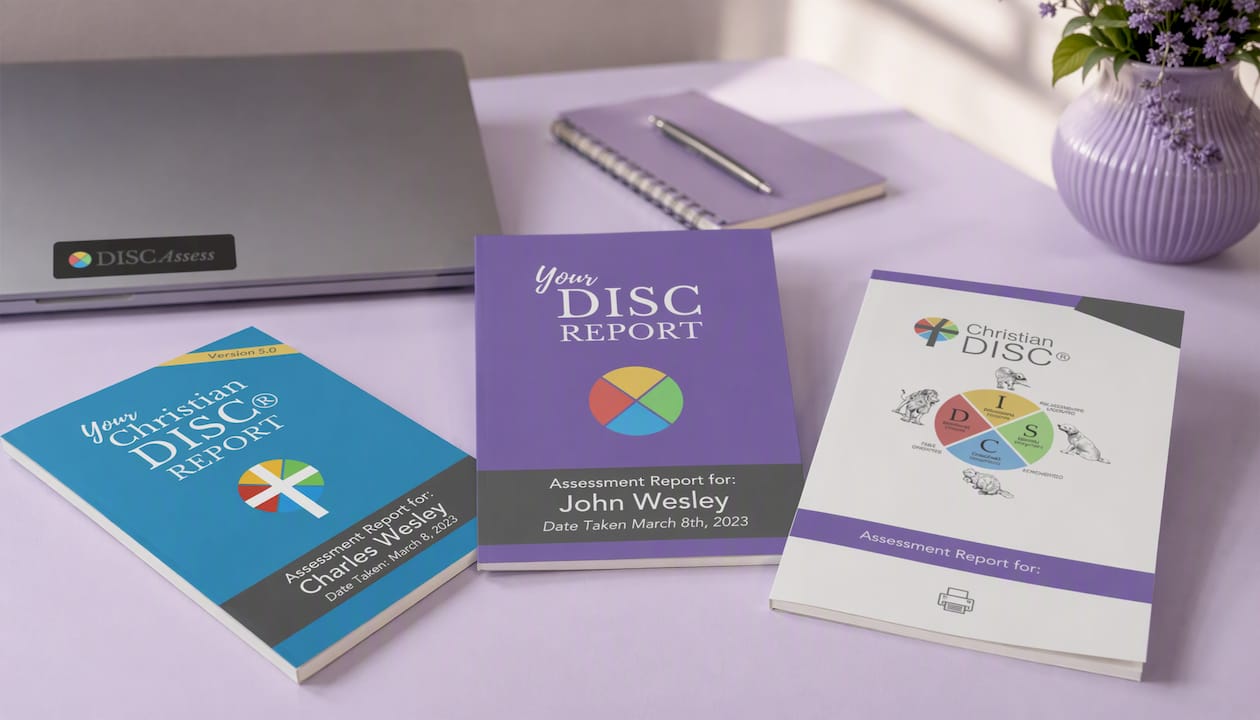
If you're evaluating this for yourself, start with the Individual Classic DISC Personality Assessment and get your full report in minutes. If your faith shapes how you want to grow in this area, the Christian DISC Spiritual Personality Assessment frames the same DISC insights through a discipleship lens. Coaches and ministry leaders running this with a group repeatedly can save with the Christian DISC Printable Assessment Bundle, a lifetime license with no per-use cost. Pick the option that matches how you plan to use it, and get your report today.
Frequently Asked Questions
Is there a truly free communication style assessment online? Yes. Several free quizzes deliver instant results in under five minutes with no signup, though some ask for an email before releasing your full report.
How accurate is a free communication style quiz? It's accurate as a self-reflection snapshot, not as a validated psychometric test. Treat your result as a starting point, then confirm patterns with feedback from someone who knows you well.
What's the difference between DISC and the four communication styles model? DISC measures four behavioral tendencies (Dominance, Influence, Steadiness, Conscientiousness), while the four-style model sorts communication into assertive, passive, aggressive, and passive-aggressive patterns.
Do I need to sign up or give my email for a free assessment? Not always. Many quizzes show results instantly with no account. Others require an email to unlock the full report, which is worth checking against the site's data retention terms.
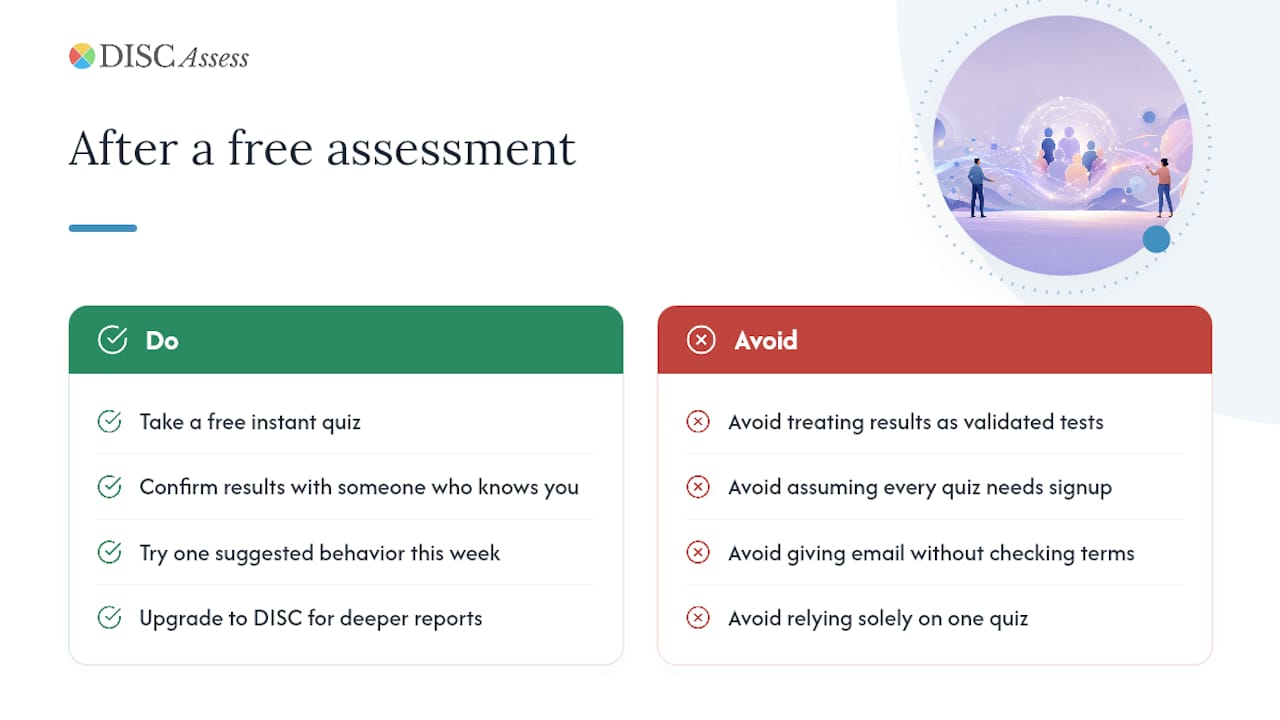
What should I do after taking a free communication style assessment? Pick one suggested behavior from your result and try it in a real conversation this week. If you want a deeper, more detailed report or team features, an upgraded DISC assessment is the logical next step.
Sources
- Communication Styles Quiz: How Do You Communicate? | Verywell Mind
- Assertiveness skills — NDSU Counseling Center
Recommended
- Communication Style Assessment Coaching for Team Leaders
- Free DISC Assessment - DISC Assess | Affordable, Professional DISC Assessments for Small Businesses
- The Appeal of DISC: Why People Love Using This Popular Personality Assessment - DISC Assess | Affordable, Professional DISC Assessments for Small Businesses
- How the DISC Compares to 3 Other Popular Personality Assessments - DISC Assess | Affordable, Professional DISC Assessments for Small Businesses